



Apartment Reputation Management: Sentiment Analysis, SEO Impact & Industry Tips



Table of Contents
Every professional in the multifamily industry, from on-site teams to portfolio managers, knows the power of a good reputation. Today, a prospective resident’s first impression isn’t formed by a drive-by or a call to the leasing office. It’s formed on Google, where they scrutinize reviews to decide if a community is even worth a tour.
Your digital marketing team has likely told you that a better review presence improves Search Engine Optimization (SEO). But how much does it really matter? Does a 4.8-star rating on Google actually lead to better organic search visibility than a 4.2?
To find the definitive answer, the organic search team at Agency FIFTY3 conducted a sentiment analysis of over 40,000 Google reviews. We dug into the data to uncover how review sentiment impacts your community’s organic search visibility, what residents really care about, and how we are setting the new industry benchmarks.
Key Takeaways:
- A property’s average star rating on Google has a moderate negative correlation (r = -0.491) with its non-branded ranking position. In other words, the higher your star rating, the better your organic search visibility.
- The best-performing review category is Staff & Management (0.49 sentiment), while the worst is Move-out (-0.70 sentiment), revealing a major operational pain point.
- Collecting private feedback from residents is the most effective way to identify and fix operational issues before they become a negative public review.
- When it comes to collecting resident feedback, SMS is nearly twice as effective as email, boasting a 3% total response rate compared to email’s 1.5%.
What is multifamily/apartment reputation management?
Multifamily/apartment reputation management is the active process of monitoring, influencing, and managing the public perception of an apartment community across all digital platforms. It is your community’s digital curb appeal and word-of-mouth marketing, rolled into one. It’s about ensuring that when a prospective renter searches for your community, they find a consistent, trustworthy, and positive narrative.
The renter’s journey starts with a search, and what they find online directly shapes their decision. According to BrightLocal’s 2025 Local Consumer Review Survey, a staggering 96% of consumers read online reviews for local businesses. While Google is the undisputed king of review platforms, it’s not the only one that matters. The same study found that 74% of consumers use two or more websites to vet a business. For apartment hunters, this means they are cross-referencing your Google Business Profile with industry-specific hubs like Apartments.com, Yelp, and ApartmentRatings. An inconsistent or negative presence on any of these platforms can create doubt and send a qualified lead straight to your competitor.
Review platform popularity
We know that prospects check multiple platforms, but where are current residents most likely to leave a review? Our team analyzed a full year of review data from November 2024 to November 2025 to find out.
The results are decisive. Google is the clear winner for multifamily reviews, capturing 88% of the total volume. The remaining platforms combined account for just 12%, with Apartments.com and Facebook each at 4%, followed by Yelp (3%) and ApartmentRatings.com (1%).

While Google is the absolute priority for reputation management, a complete strategy must still account for the other key sites where prospects form their opinions.
Sentiment analysis of 40,000 reviews
A community’s average star rating has long been the go-to metric for its online reputation. But this single number is a blunt instrument. It often hides the detailed feedback that truly matters. A resident might praise the responsive maintenance team while simultaneously expressing frustration over outdated amenities. This complexity is where the real insights are found; the actionable details that get lost in a simple 1-to-5 score.
For example, the review below has a star rating of 2, but that doesn’t tell the whole story.
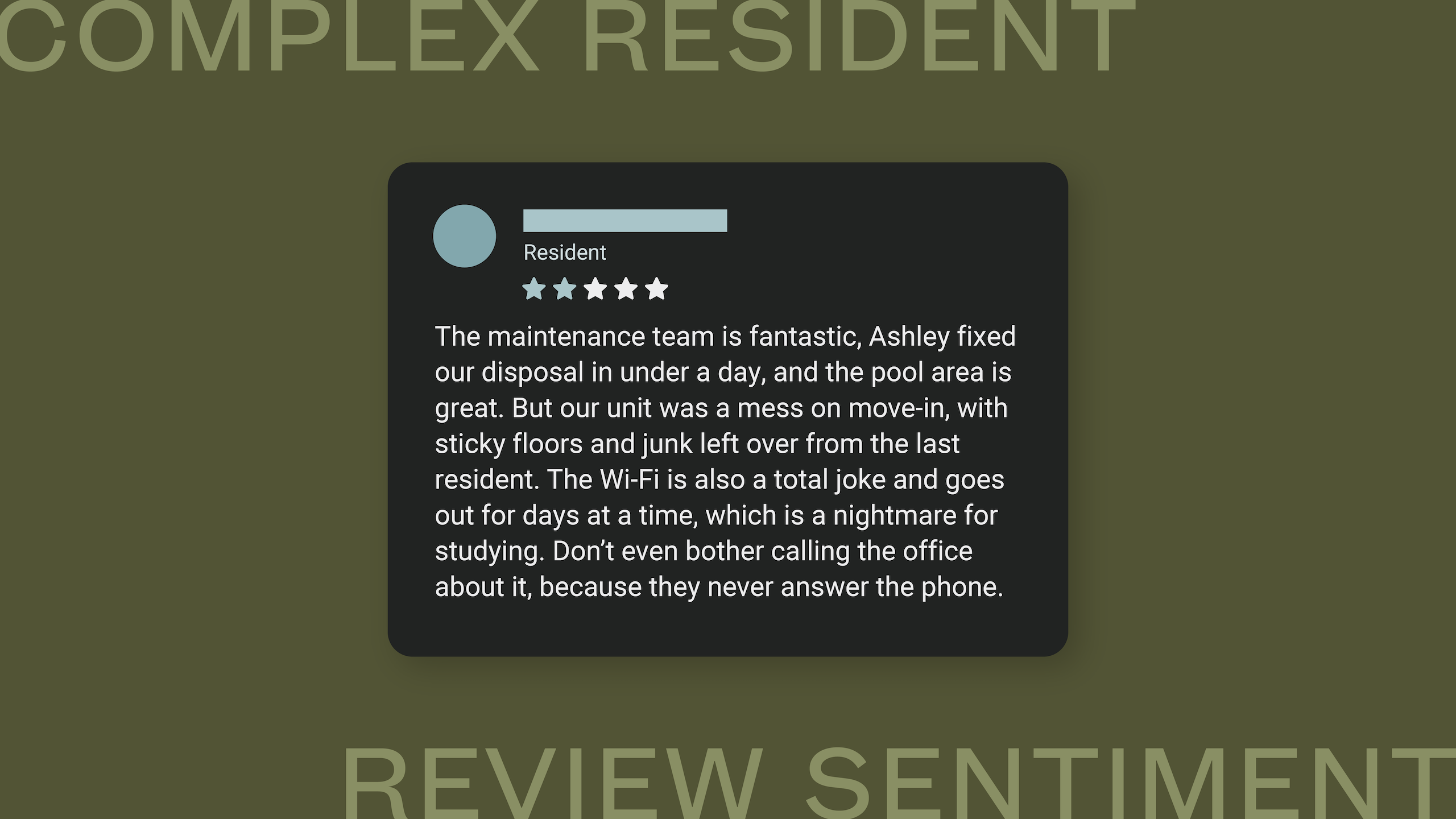
This layered feedback is exactly why a simple star rating falls short. To quantify this complexity at scale, our team conducted an in-depth sentiment analysis of over 40,000 Google reviews. Instead of relying on a star system, we scored the language in each review on a granular scale from -1 (highly negative) to +1 (highly positive). This method captures the specific emotional intensity behind a resident’s words, providing a much clearer picture of their experience.
To provide actionable insights for property managers, we broke down the sentiment into eight key operational categories that cover the entire resident lifecycle:
- Community & Environment
- Leasing Process
- Maintenance
- Move-in
- Move-out
- Staff & Management
- Unit & Amenities
- Value & Cost
This detailed approach allowed us to create the first true sentiment benchmarks for the multifamily industry.
Sentiment averages broken out by category
The data reveals a clear trend: the human elements of apartment living are the industry’s biggest strength. Staff & Management (0.49) and Community & Environment (0.48) not only have the highest sentiment scores but are also the most frequently discussed topics.
However, the data also pinpoints significant friction during key transactional moments. The Move-out process is a major source of resident frustration, earning a deeply negative sentiment of −0.70. Similarly, Values & Cost (−0.35) is another key driver of dissatisfaction. Other crucial touchpoints like Maintenance (0.14) and Move-in (0.23) hover closer to neutral, highlighting them as major opportunities for communities to improve and stand out.
| Multifamily Sentiment Analysis Metrics | ||
|---|---|---|
| Category | Sentiment | Percent of Reviews |
| Leasing Process | 0.35 | 31% |
| Move-in | 0.23 | 13% |
| Move-out | -0.70 | 5% |
| Staff & Management | 0.49 | 78% |
| Maintenance | 0.14 | 31% |
| Unit & Amenities | 0.38 | 57% |
| Community & Environment | 0.48 | 61% |
| Values & Cost | -0.35 | 24% |
Improving these sentiment scores is key to building a better reputation, but the benefits are not just about perception. They have a direct impact on your search rankings.
Google reviews’ impact on SEO
It’s a long-standing claim in the SEO community: a healthy review presence on Google can boost your local search rankings. We analyzed ranking data from a sample of 166 multifamily communities to find out if this theory holds true.
Our findings confirm a direct link. A community’s average star rating has a moderate negative correlation ( r= −0.491) with its non-branded ranking position on Google.
In simple terms, this means the higher your star rating, the better your search visibility. As your star rating increases, your average ranking position improves, putting your community in front of more prospective renters.
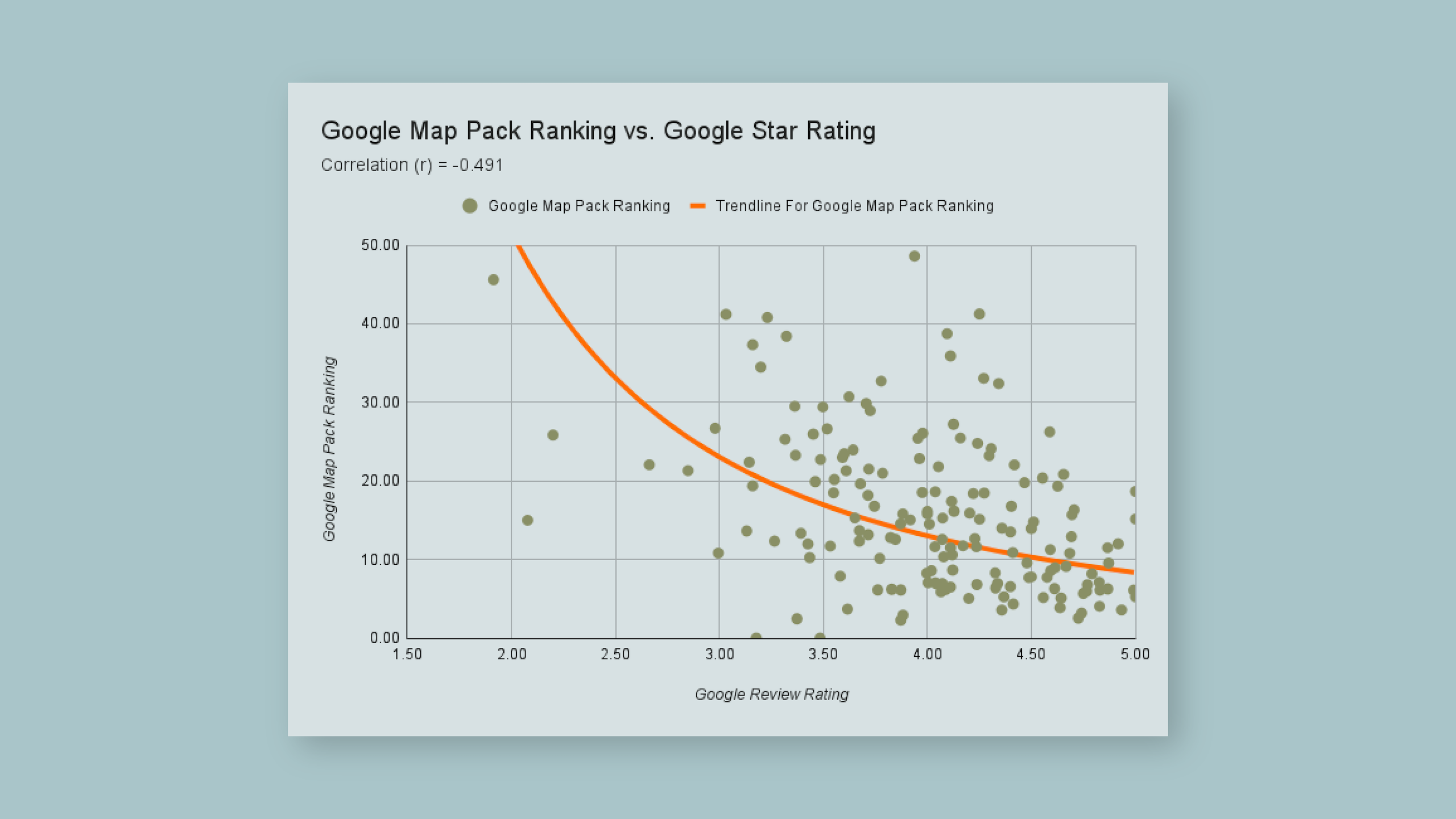
This correlation reflects Google’s mission to show searchers the best, most trustworthy results. Think of a high star rating as a powerful vote of confidence. It’s a clear signal of a quality business, which is why the algorithm rewards communities with a proven track record of resident satisfaction.
Strategies to improve your community’s reputation
Improving your online reputation requires a proactive, multi-faceted strategy. A successful approach goes beyond just responding to comments; it combines smart automation, genuine resident engagement, and a commitment to operational excellence that prevents negative reviews from happening in the first place.
Here are the key tactics your team can implement to build a five-star reputation and drive organic visibility.
Use smart automation to capture timely feedback
The days of manually sending a mass email blast and hoping for a few good reviews are over. That approach is inefficient and not necessarily well timed. The most effective way to gather a steady stream of relevant feedback is with smart automation. If your reputation management platform doesn’t have an API connection to your community’s CRM (like Yardi, Knock, or Entrata), you are missing your single greatest opportunity.
This direct integration is a game-changer. It allows you to automatically send a feedback request via SMS or email at the exact moment a key event happens in a resident’s journey. This automated, event-based approach ensures you’re asking the right question at the right time.
Key triggers should include:
- Tour Completed: Ask a prospect for feedback on their experience while it’s still fresh.
- Move-In: Check in a few days after they’ve settled in to solve any initial problems.
- Maintenance Request Completed: Sending a follow-up right after a ticket is closed is the best way to gauge satisfaction with the entire service process.
- Lease Renewal: Send a “pulse check” to gauge sentiment before it’s time to renew.
- Move-Out: Capture detailed exit feedback to learn from the experience.
- General Feedback: Send quarterly or semi-annual check-ins to monitor overall community health.
Here’s the most critical part: a sophisticated platform lets you choose the type of feedback you solicit. For a high-satisfaction trigger like “Tour Completed,” you can send the prospect directly to Google. But for a high-friction event like “Move-Out,” you can set the trigger to request internal feedback. This allows you to gather honest, unfiltered data to identify operational problems without risking a public 1-star review.
Based on data from our reputation management platform, here are the industry average ratings for each key automated event trigger:
- Tour: 4.5
- Move In: 4.2
- Maintenance Request: 4.2
- Lease Renewal: 4.1
- General Feedback: 3.7
- Move Out: 3.3
This data was collected over a full year to provide a comprehensive industry benchmark.
Use internal feedback to find and fix problems
A public review site shouldn’t be the only place a resident can voice their opinion. When a resident is frustrated, they often just want to be heard. If their only option is Google, you’re practically asking for a public 1-star review.
Providing a private channel that is easy to access for internal feedback is the most effective way to prevent this. This feedback is a direct, unfiltered line of communication to your on-site team. Think of it as free, high-value consulting. It’s where you’ll find the specific, actionable insights needed to improve your operations—information that leads to a better resident experience and better public reviews down the line.
However, a system for collecting feedback is useless if no one is listening. Your team must be trained to review this internal feedback daily and respond to the resident. Simply offering an outlet and then ignoring the comments is worse than not asking at all. By contrast, a prompt and personal follow-up shows you are genuinely engaged, solves the problem, and can turn a frustrated resident into a loyal one.
Don’t “set it and forget it”: optimize your strategy with data
A successful reputation management strategy is not static. You can’t just “set and forget” your automated campaigns. The key is to constantly review the performance of both your internal and external feedback on a monthly and 6-month trending basis.
This data-driven approach is critical for making smart, agile decisions.
- Scenario 1: You spot a negative trend. You notice the public rating for your “Maintenance Request” trigger has dropped significantly. Your immediate action should be to switch that campaign to “internal feedback only.” This instantly stops the public bleeding and gives your team a chance to use that private feedback to diagnose and fix the root cause without further damage to your public star rating.
- Scenario 2: You spot a positive trend. Six months ago, your “Move-In” process had a low score, so you set it to “internal only.” Now, your 6-month trend data shows the internal satisfaction score has climbed from a 3.3 to a 4.5. This is your signal to switch that campaign back to collecting external reviews and showcase your team’s improvements to prospects.
This level of active management transforms your reputation platform from a simple review-gathering tool into a powerful operational management system.
Dig deeper with targeted resident surveys
While automated triggers are perfect for tracking the standard resident lifecycle, you also need a way to get feedback on specific, one-time events. This is where targeted surveys become a powerful tool. Surveys are an excellent way to “pulse check” your community on specific initiatives.
For example:
- Did you just host an on-site event?
- Are you gathering feedback on a recent lobby renovation?
- Are you thinking of changing Wi-Fi providers and want to gauge current satisfaction?
These simple surveys give you immediate, actionable data on the projects your team is investing in, helping you make better decisions on what residents really value.
Drive higher response rates
Automating when you ask for feedback is the first step, but how you ask is just as critical. We analyzed the performance of over 3.2 million campaign sends from the last year to compare the response rates of SMS versus email.
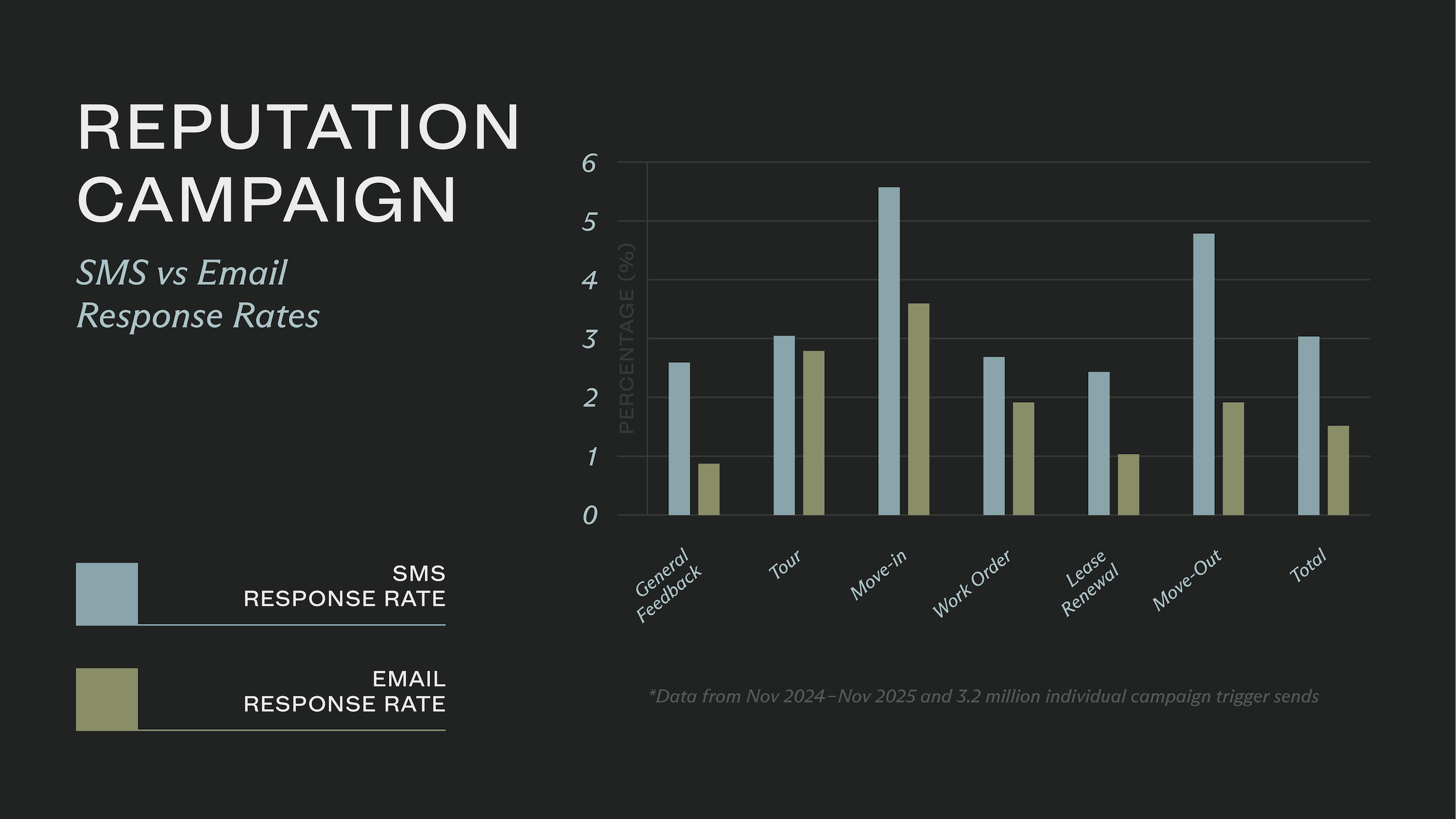
Overall, the total response rate for SMS (3%) is double that of email (1.5%).
This trend holds true for every trigger, but the gap is particularly wide during high-friction events. For Move-Out, SMS (5%) is more than twice as effective as email (2%). The takeaway is clear: if your reputation platform only sends email requests, you are missing out on a massive volume of potential feedback.
Reputation pitfalls to avoid
A proactive reputation strategy is essential, but it’s just as important to understand what not to do. Certain tactics can easily backfire, leading to resident fatigue or putting your online profiles at risk by violating platform guidelines.
Here are the most critical mistakes to avoid.
Avoid resident communication fatigue
Your residents’ inboxes are already full. Adding too many feedback requests on top of regular community announcements and maintenance updates is the fastest way to make them tune you out. Be mindful of the resident’s journey. Moments like move-in and move-out are already chaotic.
If your automated platform is set to send a feedback request for these events, do not send an additional custom survey on the same topic. Be strategic, respect their time, and consolidate your requests.
Keep your review strategy compliant with platform policies
Earning a strong reputation on Google is a marathon, not a sprint. Trying to take shortcuts can get your profile penalized. It’s critical that your team understands and adheres to Google’s policies to protect your community’s most valuable digital asset. Violations can lead to Google removing reviews or, in severe cases, placing restrictions on your Google Business Profile.
Here are the three most common violations to avoid:
- Incentivizing Reviews: You cannot offer gift cards, rent discounts, contest entries, or any other monetary reward in exchange for reviews. This is especially common in student housing with tactics like, “Leave us a review and get a free slice of pizza.” Even if you aren’t explicitly asking for a positive review, the incentive itself is the violation.
- Review Gating: This is the practice of pre-screening your residents on an individual basis and only directing the “happy” ones to leave a public review. Your solicitation process must be uniform and offer the same options to all residents.
- Conflict of Interest: You generally cannot review your own business. This includes asking employees to leave 5-star ratings for their workplace, or soliciting reviews from friends and family who are not actual residents. Google classifies these as fake or biased because they do not reflect a genuine customer experience.
These policies aren’t just suggestions; Google actively enforces them, and the penalty can be a public-facing warning that destroys your credibility.
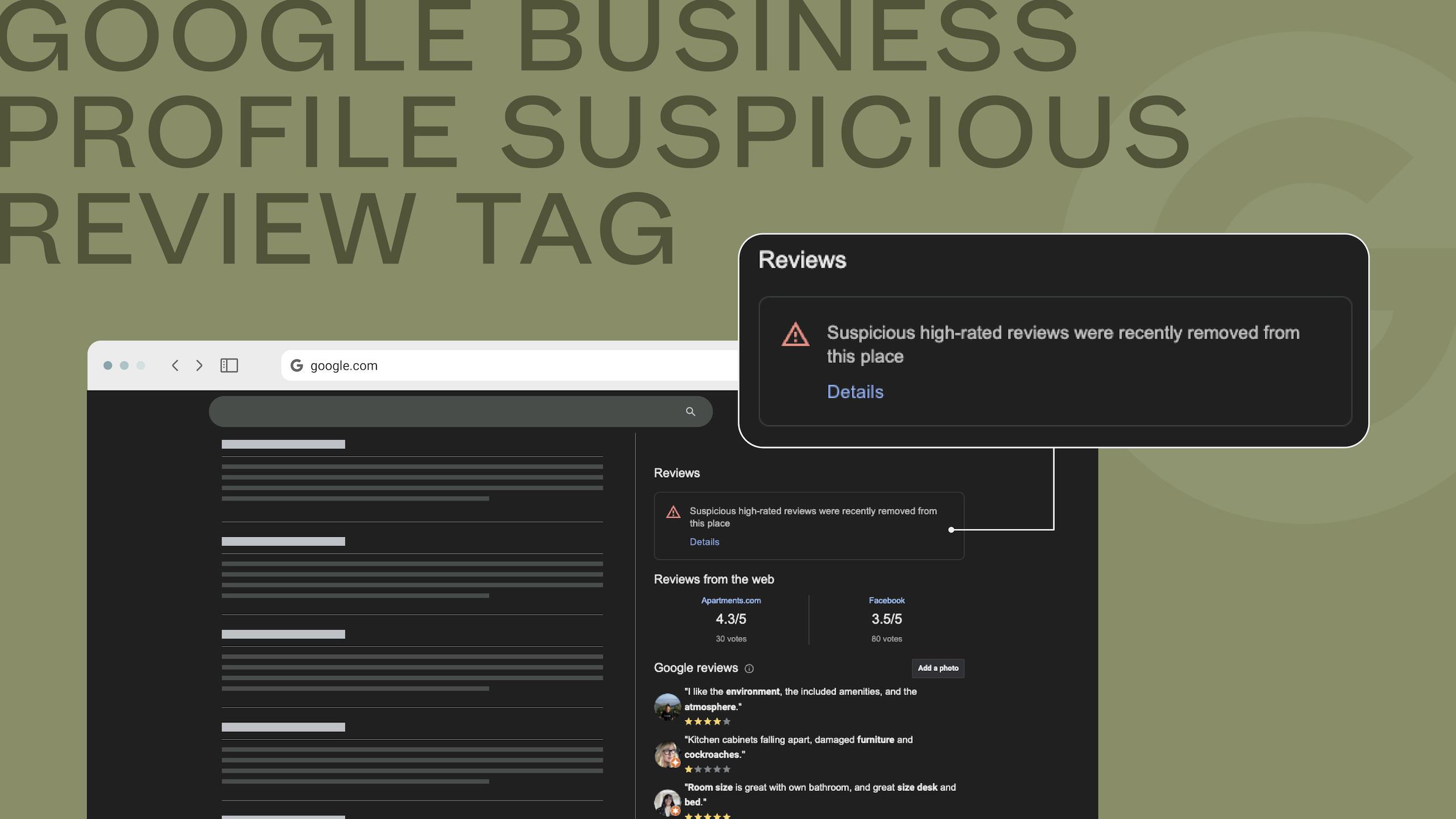
The best and safest strategy is simple: provide an excellent resident experience and make it easy for all residents to share their genuine feedback.
Building a 5-star strategy that lasts
Multifamily reputation management is no longer an operational task; it’s a critical, data-driven component of your digital marketing strategy. Our analysis proves that what residents say online is not just about perception. Your community’s reputation has a direct, measurable impact on your bottom line.
A higher Google star rating is linked to better non-branded search visibility. This means your community’s ability to earn a top spot on Google is intrinsically tied to your on-site team’s ability to deliver a 5-star resident experience.
The path to achieving this is clear:
- Listen strategically by using automation to capture feedback at key moments.
- Act decisively on internal feedback to fix core problems before they become public complaints.
- Optimize intelligently by monitoring performance data and choosing the right channels (like SMS) and strategies for your campaigns.
By focusing on the operational details that solve for the industry’s biggest pain points, such as Move-Out (-0.70 sentiment) and Value (-0.35 sentiment), you aren’t just building a better reputation. You are creating a powerful, long-term SEO asset that will drive more qualified, non-branded leads to your community.
Ready to build a 5-star reputation that drives rankings? Contact our team to get started.
* For readability, some percentages and figures in this article have been rounded. This rounding does not change the core findings or message of our research.

Sign up for our newsletter.
Stay in the know about our insights and industry trends.
