



Your Guide to Multifamily & Apartment SEO Success



Table of Contents
Let’s start with the basics: search engine optimization (SEO) helps search engines understand the content on your website, landing page, and in blog posts just like this one. When search engines understand your content, they can more accurately show it to relevant users. In short, SEO helps your potential residents find you online. And the right apartment SEO strategies can get you more organic clicks, which saves you money on paid search efforts in the long run.
But to do it right, SEO for apartments means optimizing multiple on-page, off-page, and technical elements of your website. While that can feel like a lot to do, it’s definitely worth it. A well-executed multifamily SEO strategy can put your community website above major Internet Listing Services (ILSs) — like Apartments.com and Zillow — on the search engine results page (SERP).
In this guide, we’ll take you through each piece of that SEO to-do list, demystifying on-page, off-page, and technical SEO so you can understand what factors actually improve your organic ranking and which ones to avoid.
Key Takeaways
- With an average website conversion rate of 3.4%, organic search traffic has the highest conversion rate of any digital marketing channel.
- Local SEO strategy that prioritizes the Google Map Pack helps you outrank major ILSs, like Apartments.com and Zillow.
- Good, SEO-optimized blog content reduces the thin content on your website, lets you reach prospective residents through other relevant searches, and helps you stand out from competitors.
Why your apartment website needs SEO
A good apartment SEO strategy means, when someone types “apartments in denver co” into Google, your Denver apartment community will show up in their search results. The ultimate goal is to optimize your multifamily website so well that it climbs the page ranking to page one and then into the top 1-5 results. This puts your brand right in front of the people who are searching for your offering and makes it more likely that they’ll discover your brand, click on your website, and contact your team.
Sure, you could be at the top of that SERP with a good paid ads strategy, but paid ads require you to pay for every click you get. And today’s audience understands the basics of sponsored search results; data shows the click through rate (CTR) for the top organic search result can be as high as 39%, while the #1 paid ad is 2%.
An organic search result is all in the name: you implement long-term strategies that naturally get you to the top of SERP, and your audience perceives that organic result as the most relevant and trustworthy in their search.
In multifamily SEO specifically, our analysis also shows organic traffic is more likely to convert than any other traffic source. Our marketing experts analyzed 2024 Google Analytics 4 data from 18.3 million sessions on 370 multifamily websites and found that organic search had the best-performing metrics of all sources.
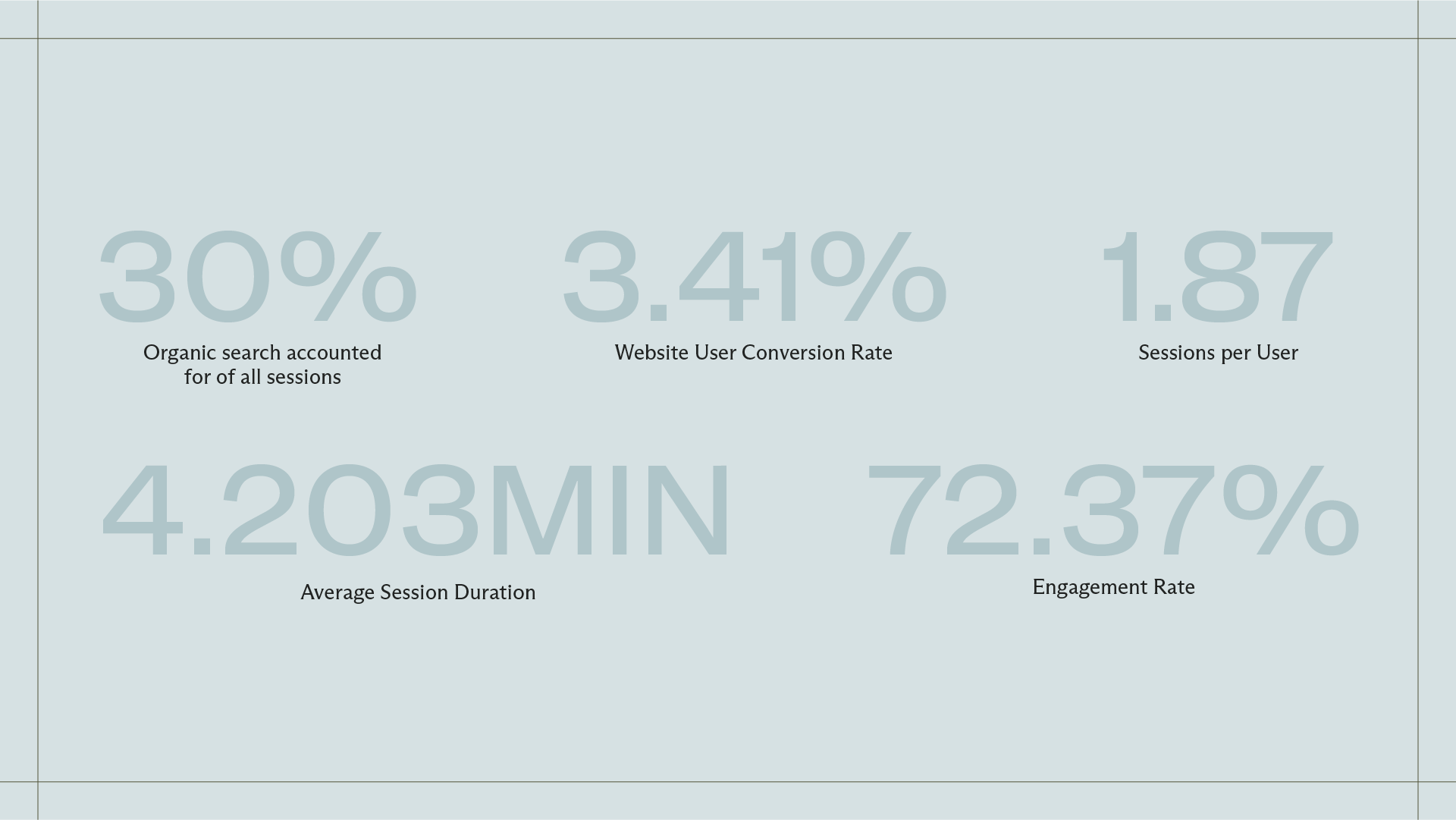
That’s not to say SEO should or could replace paid ads. Especially in the highly competitive multifamily market, these digital marketing strategies work together — each with their own unique pros, cons, and use cases — to get you the best leads.
How to use apartment SEO to outrank ILSs
Major ILSs, like Zillow, dominate page one search results for many apartment-related search terms in large part because they have massive backlink profiles. That means other sites or posts all over the internet link to Zillow pages, and that makes Google think they have the best results, the results people want to see and share. On sites with automatic URL linking, Apartments.com gets a new backlink every time you type their brand name. A single apartment website will simply never get the same number of backlinks.
But have no fear! Your single apartment website can still climb the rankings and show in top results.
One big plus: those ILS websites are not eligible to show up in Google’s Map Pack. The Map Pack, also known as “local pack” or “3 pack,” features local, brick-and-mortar businesses. It’s located at the top of the organic search results as an interactive Google Map. Because ILSs are online directories and not brick-and-mortar businesses, they’re not eligible to show up in the Map Pack, and your community is.
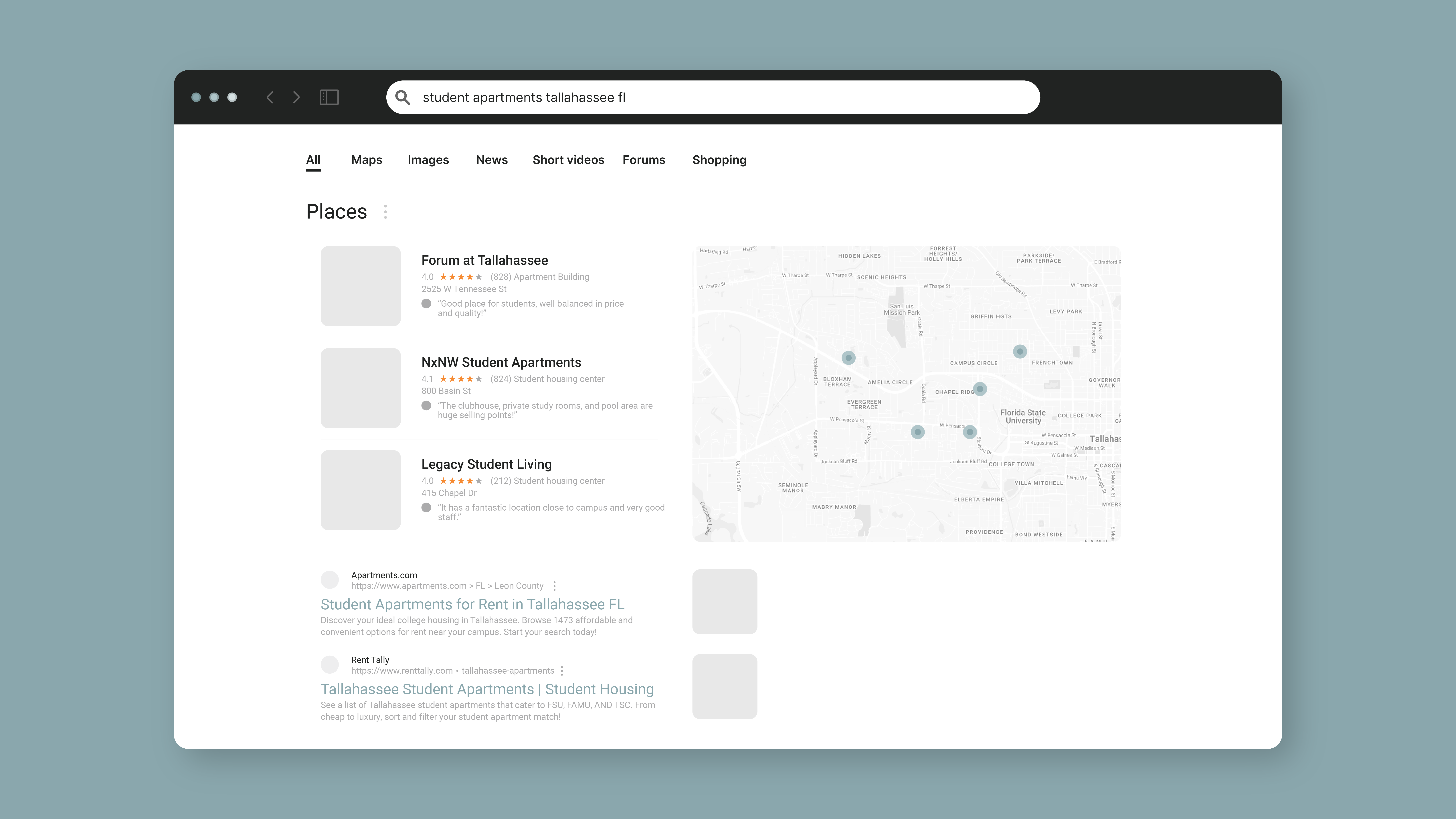
But how do you get your apartment website in those top results? Now, we’ll get into the off-page, on-page, and technical SEO optimizations that build authority and trust with Google long-term.
On-page SEO for apartments
On-page SEO optimizes the elements that are visible to your users when they’re on your site: compelling and relevant content that uses target keywords, proper heading structure, image optimization, and mobile-friendliness.
Keyword strategy & optimization
Keyword strategy starts with research (a lot of it). Using tools like SEMrush, Ahrefs, and Google Ads Keyword Planner, an experienced SEO strategist can find out the best page layouts, what keywords people are searching for, and even why they’re searching for it.
The most common mistake in multifamily SEO is targeting keywords that are too general. For example, let’s say you have a Class A luxury community in Denver’s Cherry Creek neighborhood. You need a keyword strategy that is geographically relevant, describes your community, and gets you higher CTR, lower funnel clicks.
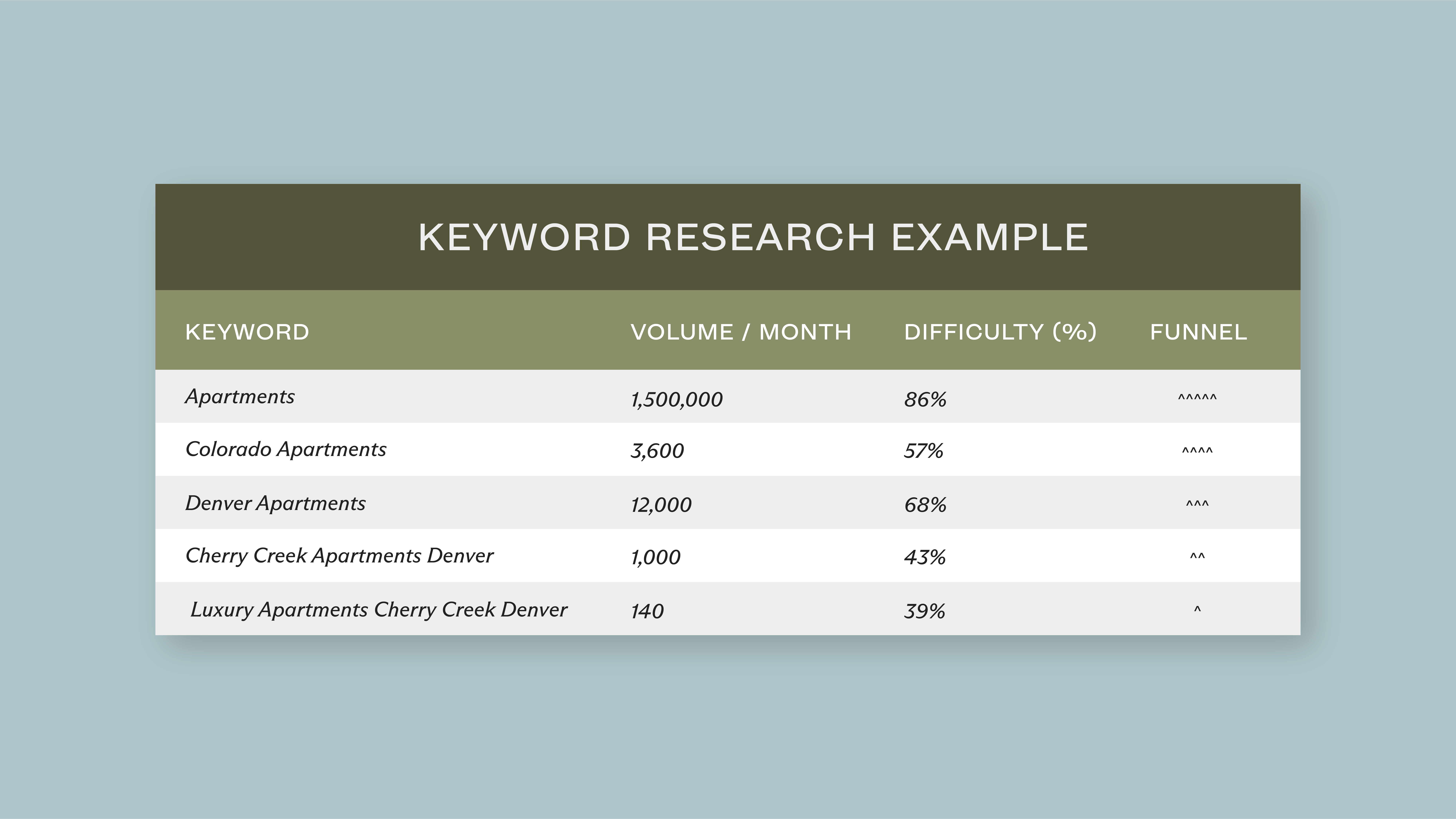
In this chart, we show the highest funnel and most broad keyword option, “apartments.” Even “colorado apartments” is too broad, which shows in the monthly search volume. Not many people are searching for apartments just anywhere in Colorado; most searchers will have a specific city or neighborhood they want to live in. That’s where we get to long-tail keywords that describe your luxury community and specific Cherry Creek location.
Short-tail keywords are broad, general terms, typically one or two words in length, like “apartments” or “apartments near me.” These may offer high search volume, but they also face intense competition, which makes it difficult for a single community to rank at all. And because they’re so broad, their conversion rates tend to be low. All the way at the top of the funnel, these searchers may just be looking for a general idea with no intent to convert.
Long-tail keywords are longer, specific phrases that get you more clicks and conversions. Often three or more words, they may include specific characteristics your audience is searching for, like “pet friendly studio apartments” or “denver apartments with in unit washer and dryer.” These have lower search volume but significantly less competition, which means fewer people are searching for them and it’s easier for your website to rank in results. Crucially, these searchers are already narrowing down their options with clear intent to sign a lease.
Title Tag, Meta Description & Headings
Optimizing your Title Tags, Meta Descriptions, and Headings with target keywords is fundamental to gaining visibility. These elements set the stage for your website’s success.
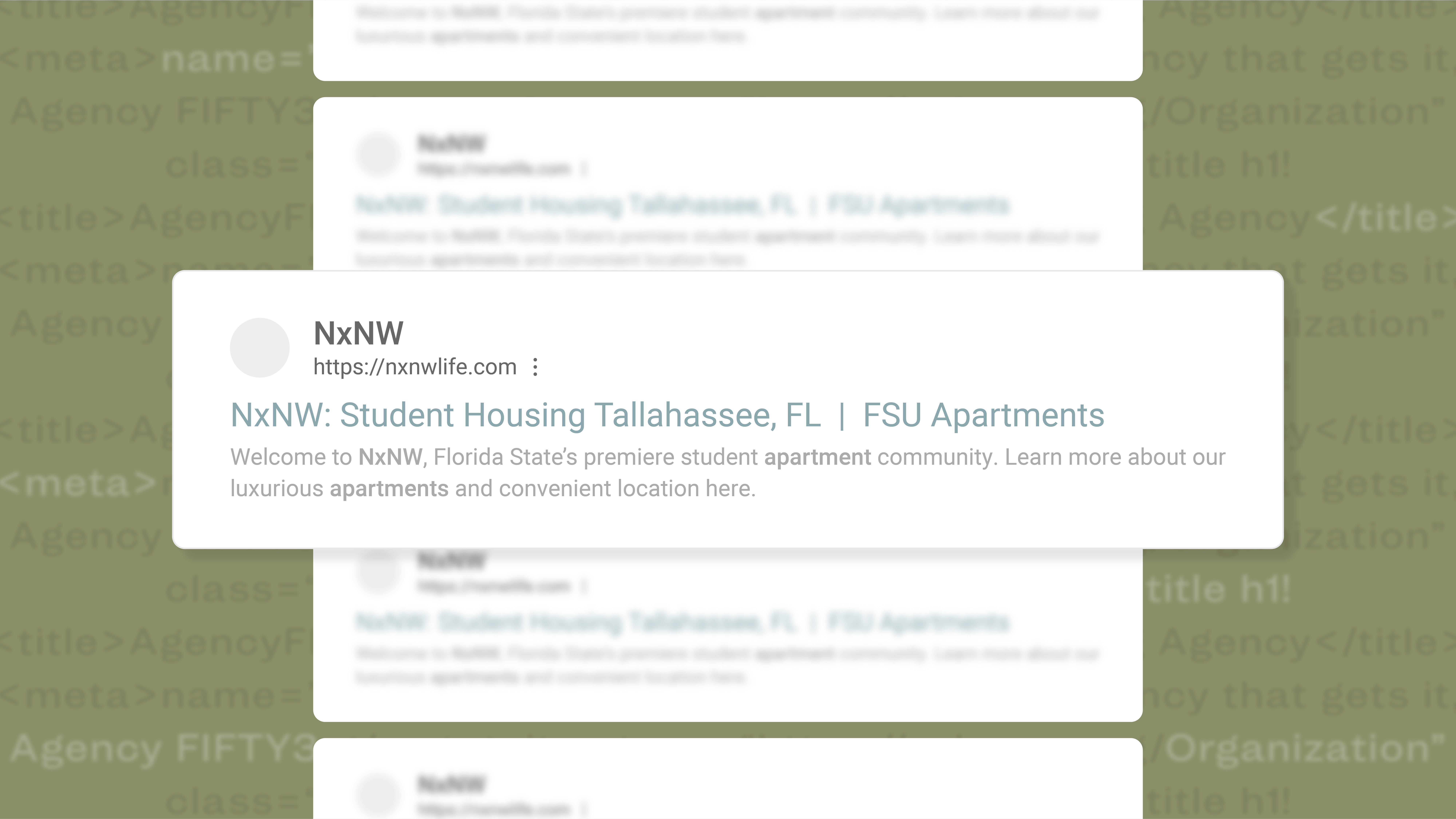
Title Tag: The title tag is the clickable headline for your page that appears in the SERP. It’s a powerful signal to search engines about your page’s topic. A well-crafted title tag that includes keywords, accurately reflects the page content, and entices users to click can directly improve your click-through rate (CTR), which positively influences ranking.
Meta Description: While not a direct ranking factor, the meta description is the short summary that appears under your title tag in search results. Think of it as your ad copy. A compelling description can significantly improve your CTR by setting clear expectations and encouraging users to choose your result over a competitor’s.
Heading Tags (H1-H6): Headings create a clear, hierarchical structure for your content, making it easy for users and search engines to scan and understand.
- H1: This is the main headline on the page. It should be unique and include your primary keyword target, closely matching your title tag.
- H2-H6: These subheadings break your content into logical sections, improving readability and providing opportunities to include related keywords.
Image Optimization
High-quality images are essential for showing off your community and breaking up text. But beyond aesthetics, well-optimized images also improve your SEO.
- Choose High-Quality Images: Use professional photography of your amenities, units, and neighborhood. Replace renderings with real photos as soon as they are available.
- Optimize File Size: Large images slow down your website. Compress and scale images to fit their container on the page to protect your page load speed.
- Use Descriptive File Names: Search engines read filenames to understand image content. Describe the image and include relevant keywords (e.g., luxury-2-bedroom-apartment-cherry-creek-kitchen.jpg).
- Write Alt Text: Alt text provides context for search engines and is critical for accessibility, as it is read aloud by screen readers for visually impaired users.
Internal Linking
Internal linking is the practice of linking one page of your website to another page on the same domain. It’s a simple but powerful tool for on-page SEO.
- Improved Navigation: Internal links help users find what they are looking for with fewer clicks, reducing friction.
- Crawlability: They create pathways for search engine crawlers to discover and index all the important pages on your site.
- Contextual Relevance: Using descriptive anchor text (the clickable text in a hyperlink) helps search engines understand the topic of the linked page.
- Increased Engagement: A smart internal linking structure encourages users to explore more of your website, increasing session duration.
To identify pages that need more internal links, check the Pages and Screens report in Google Analytics 4. If your Floor Plans page is one of your most viewed pages (it is for our clients!), make sure it’s easy to navigate to from other key pages on your site.
Blog Posts
The multifamily industry has a content problem. The typical community website has about six pages, mostly focused on photos and amenities. This lack of copy creates “thin content”, which is pages that offer little value to users and can negatively impact search rankings.
An SEO-optimized blog is the solution. It significantly increases the amount of high-quality content on your site and helps you stand out from competitors who aren’t investing in a content strategy.
To rank for a term like “pet friendly apartments denver,” you need to build Topical Authority. This means demonstrating to search engines that you are an expert on that subject. Your blog post should be an in-depth resource covering related subtopics, such as:
- Local leash laws and breed restrictions
- Recommended local pet stores and dog parks
- A list of local veterinarians and emergency vets
- Restaurants with pet-friendly patios
- And of course, your community’s pet-friendly amenities, like a dog park or pet wash station.
While there is no shortcut to improving Topical Authority, a high-quality blog content strategy focusing on user intent and answering common questions is a proven tactic for multifamily and student housing.
Website User Interface (UI) & User Experience (UX)
While not direct ranking factors, website UI and UX significantly influence user behavior, which does impact SEO.
- UI (User Interface): This is the look and feel of your site – the buttons, menus, and visual elements. A good UI is intuitive, visually appealing, and consistent with your brand.
- UX (User Experience): This is the user’s overall journey through your site. A good UX makes it easy and enjoyable for users to accomplish their goals, which directly impacts satisfaction and conversion rates.
A positive UI/UX leads to higher engagement rates, longer time on site, and more social shares – all positive signals to search engines that your site is valuable and user-friendly.
Off-page SEO for apartments
Off-page SEO involves actions taken outside of your own website to impact your rankings. This includes building backlinks from other credible sources, ensuring your business information is consistent across online directories, and managing your Google Business Profile.
Google Business Profile (GBP)
Optimizing your Google Business Profile is critical for local SEO. The information from your GBP listing feeds directly into the Google Map Pack and the Knowledge Panel for branded searches, and powers the Map Pack for non-branded searches.
It isn’t just a map pin; it is often your highest-performing conversion tool. In our recent analysis of over 200 multifamily profiles, we found that the website link on a GBP provides the highest converting traffic of any digital medium at 7.5%.
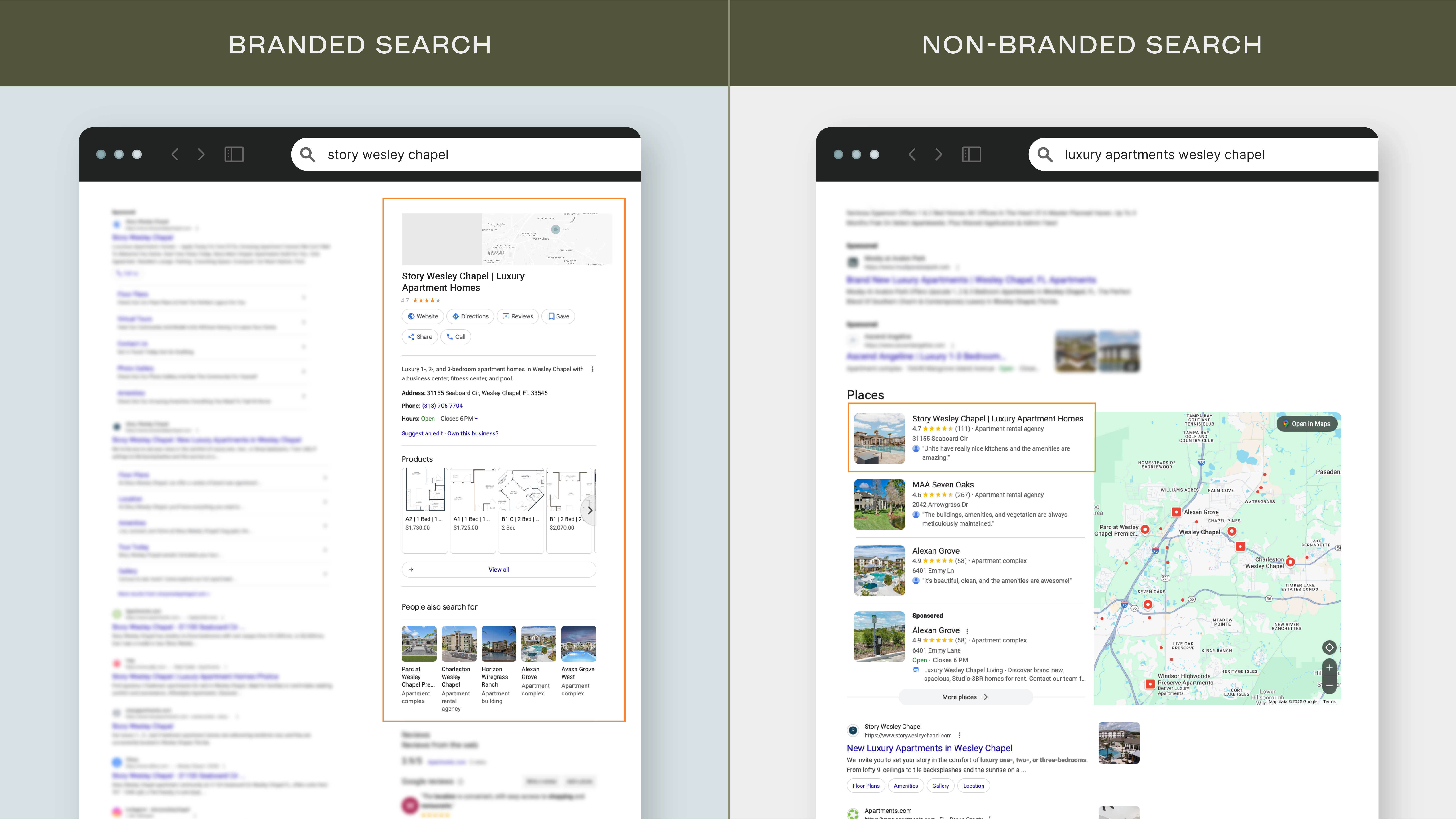
Prospects expect this information to be accurate and up-to-date. Here are the most important fields to complete:
- Essentials: Business Name, Address, Primary Phone Number (tracking number), Secondary Phone Number (number on website), and Website (with tracking parameters).
- Key Information: A compelling, keyword-rich Description, accurate Hours of Operation, and high-quality Photos & Videos.
- Actionable Links: Use the Appointment Link to direct users to your contact or tour scheduler page. Utilize Floor Plan Product Cards to showcase your layouts with up-to-date pricing and links.
- Attributes: Select all relevant attributes, especially new apartment-specific ones like “basketball court” or “dog park.”
- Trust & Engagement: Proactively manage Reviews, answer questions in the Q&A section, and use Google Posts to share updates and leasing specials.
Your GBP is not a “set it and forget it” tool. Any user can suggest edits, so monitor your profile regularly to maintain accuracy and performance.
Reputation Management
While many view reputation management as a purely operational task, it is actually one of the most potent levers in local SEO. Because major ILSs like Apartments.com and Zillow are not brick-and-mortar businesses, they cannot compete in the Google Map Pack. This is where your community can win—but only if your review signal is strong.
To find the definitive link between reviews and visibility, our team conducted a sentiment analysis of over 40,000 Google reviews across 166 multifamily communities.
We found that a property’s average star rating has a moderate negative correlation (r = -0.491) with its non-branded ranking position. In the world of SEO, this is a clear signal: as your star rating increases, your numerical ranking position decreases (meaning you move closer to the #1 spot).
A high star rating acts as a powerful vote of confidence to Google’s algorithm. It isn’t just about “social proof” for prospects; it’s a primary trust signal that tells Google your community is a high-quality result worthy of the top of the SERP.
To leverage reputation management for SEO, focus on these three data-backed pillars:
- Prioritize Google: While prospects check multiple sites, Google captures 88% of all multifamily review volume. If you have limited resources, win on Google first to impact your rankings most directly.
- Optimize Your Request Method: Don’t rely on email alone. Our data shows that SMS feedback requests are twice as effective as email, boasting a 3% total response rate compared to email’s 1.5%.
- Use Internal Feedback as an SEO Shield: High-friction events like “Move-out” carry the most negative sentiment (-0.70). By using automated triggers to collect internal, private feedback during these stages, you can identify operational “leaks” and fix them before they manifest as public 1-star reviews that drag down your Map Pack ranking.
By treating your star rating as a SEO asset rather than just a customer service metric, you create a competitive advantage for your community.
NAP Consistency & Directory Listings
NAP stands for Name, Address, and Phone Number. Maintaining NAP consistency means ensuring these three core details are identical across your website, Google Business Profile, ILSs, and other online directories like Yelp and Apple Maps. Even small variations can confuse search engines and hurt your local rankings.
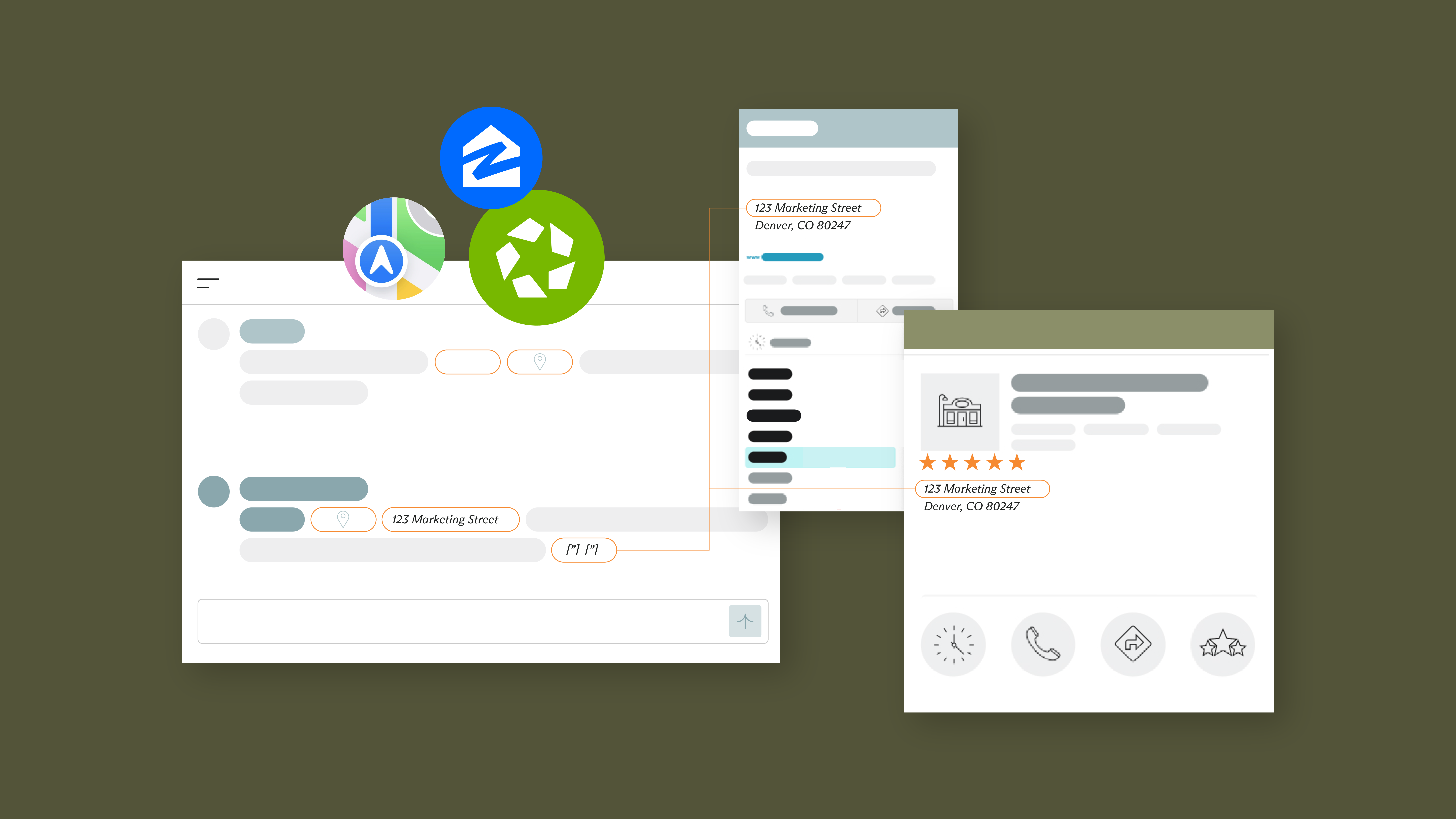
To establish and maintain consistency, choose one official format for your NAP and update it everywhere. Tools like SOCi or Yext can help you manage these listings at scale, monitor for inaccuracies, and suppress duplicate listings that can dilute your authority.
Building Backlinks
Think of backlinks as online referrals. When a reputable website links to yours, it’s a vote of confidence that signals to Google your site is a credible source of information.
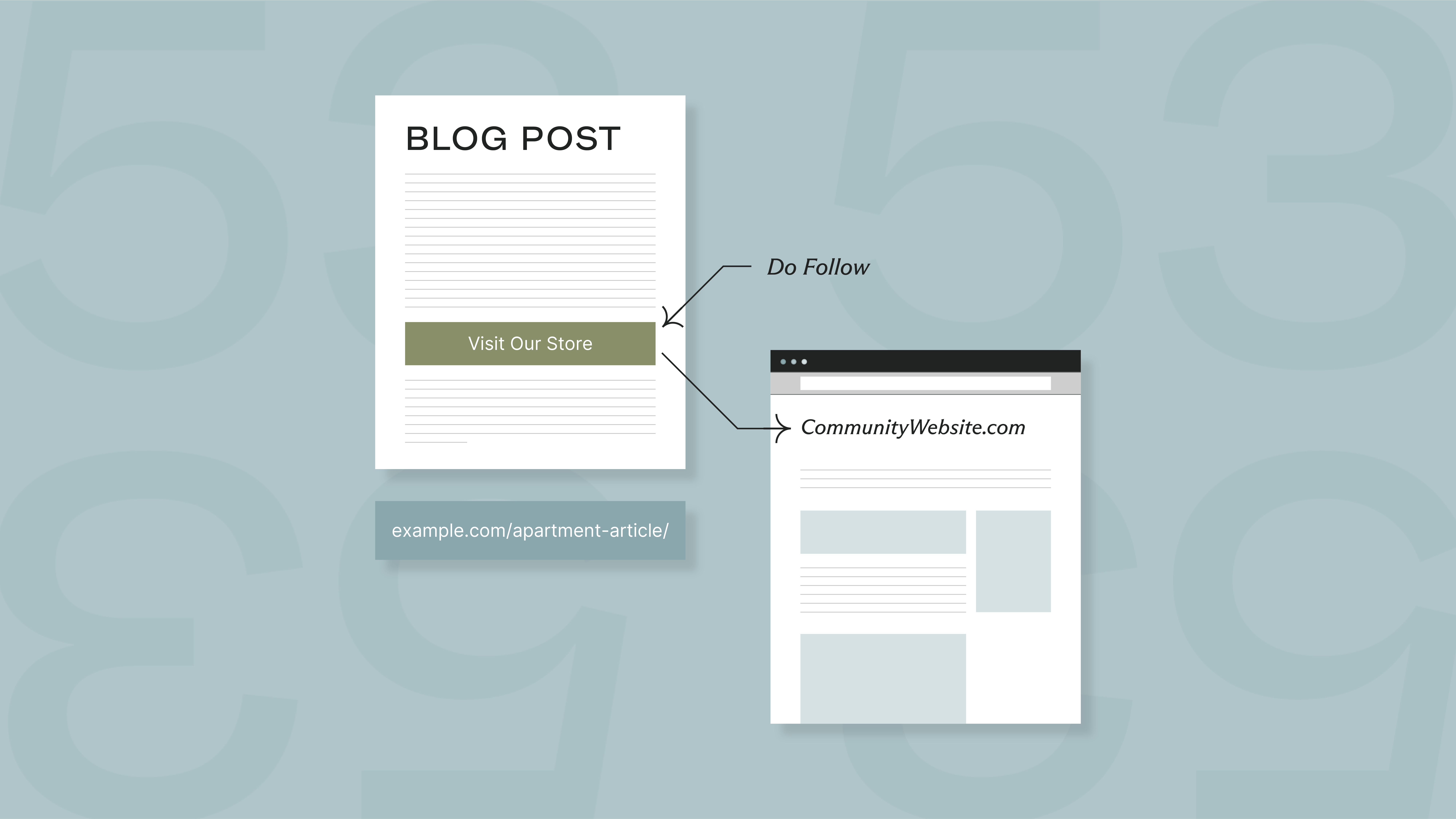
Building a strong backlink profile takes time, but here are some effective strategies:
- Content-Based: Create a high-quality blog with valuable content that other websites will want to reference and link to.
- Partnerships & Outreach: Collaborate with local employers on housing programs, get featured in local news articles about community events, or contribute guest posts to relevant industry blogs.
- Directory & Portfolio Listings: Ensure your property is listed on your property management and ownership group websites. While links from ILSs and local directories are less powerful than guest posting, they still contribute to a healthy backlink profile.
Social Media Presence
While not a direct ranking factor for your community website, a strong social media presence plays an important indirect role in your website’s SEO strategy.
- Branded Searches: Think of the SERP as a digital billboard. When someone searches your brand name, you want to own as much of that billboard space as possible. Well-maintained profiles on Facebook, Instagram, and X (formerly Twitter) will rank for your brand name, pushing competitors and ILSs further down the page.
- Non-branded Searches: As of July 2025, Google is now indexing Instagram posts. Having an engaging social content strategy may help your Instagram posts show directly in the SERP, providing searchers with another outlet to discover your community
- Google Business Profile: GBP has fields to link your social accounts, which contributes to the completeness of your profile and signals to users that your brand is active and credible.
- Schema Markup: You can include your social profiles in your website’s schema markup (more on that below), which helps Google better understand your brand’s complete digital footprint.
Technical SEO for apartments
Technical SEO is about optimizing the underlying structure of your website so search engines can effectively crawl, index, and understand its content. Think of it as making your site as easy as possible for Google’s bots to read.
This involves ensuring good crawlability (bots can discover your pages), indexability (bots can add your pages to their database), and website performance (your site is fast, mobile-friendly, and secure).
XML Sitemap
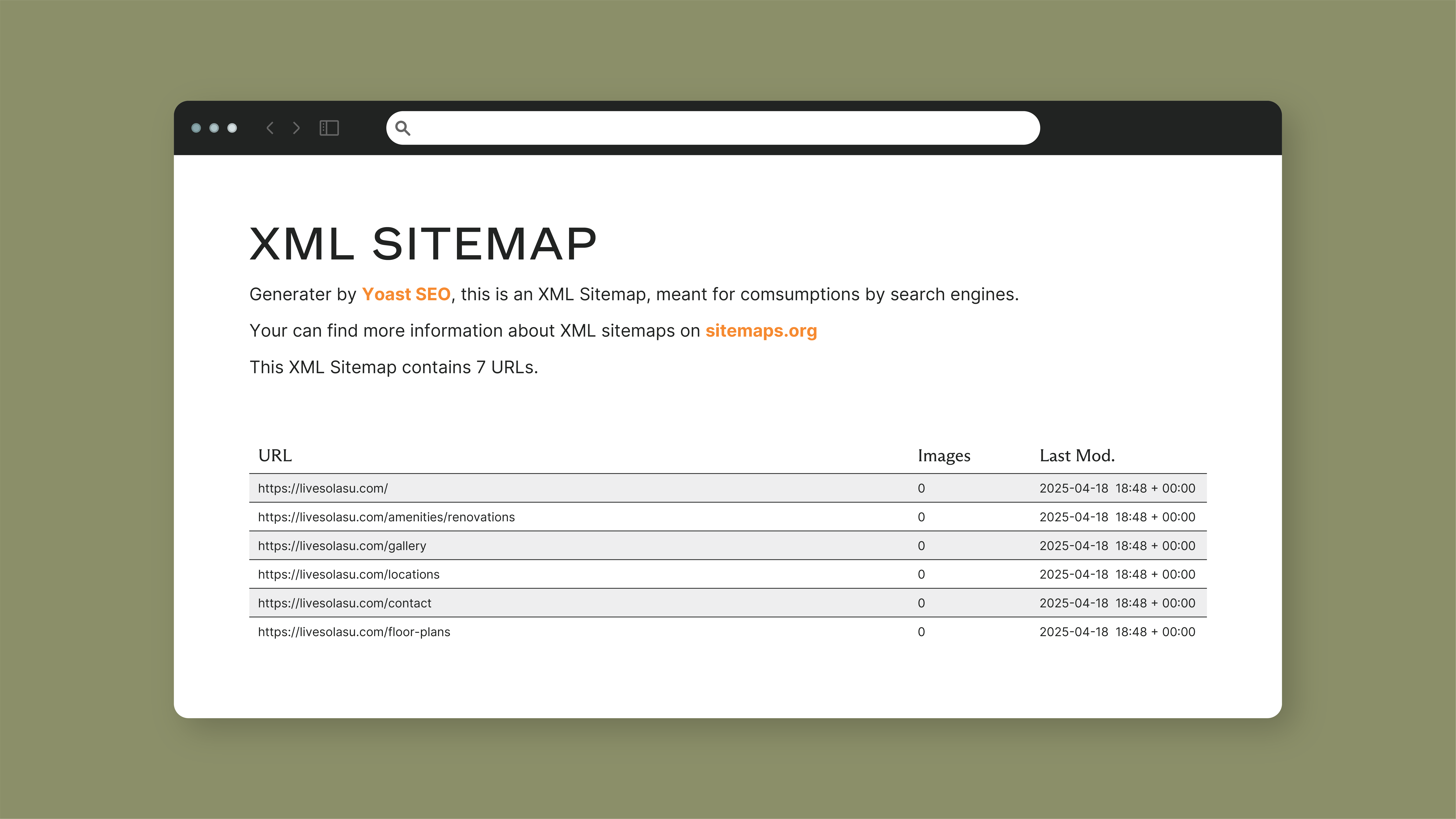
An XML sitemap is a roadmap of your website that lists all your important pages for search engines. It helps them discover content they might otherwise miss and understand when pages have been updated. Submitting your sitemap via Google Search Console can speed up the indexing process, getting your content in front of users faster.
Robots.txt File
A robots.txt file is a simple text file that gives instructions to search engine crawlers about which pages they are allowed or disallowed to access. This is useful for blocking sensitive areas, preventing the indexing of duplicate content, or keeping staging sites private. For your community website, the key is to ensure your robots.txt file isn’t accidentally blocking search engines and that it specifies the location of your XML sitemap.

HTTPS (Hypertext Transfer Protocol Secure)
Site security is a confirmed, albeit small, Google ranking signal. HTTPS encrypts the data transmitted between a user’s browser and your website, protecting sensitive information. More importantly, it builds user trust. Browsers display a padlock icon for secure sites and may show a “Not Secure” warning for those still on HTTP, which can deter visitors. To enable HTTPS, your website must have a valid SSL Certificate.
URL Structure & Domain Name
A well-optimized URL structure improves crawlability and user experience. Clear, concise URLs that include relevant keywords make it easier for both users and search engines to understand what a page is about.
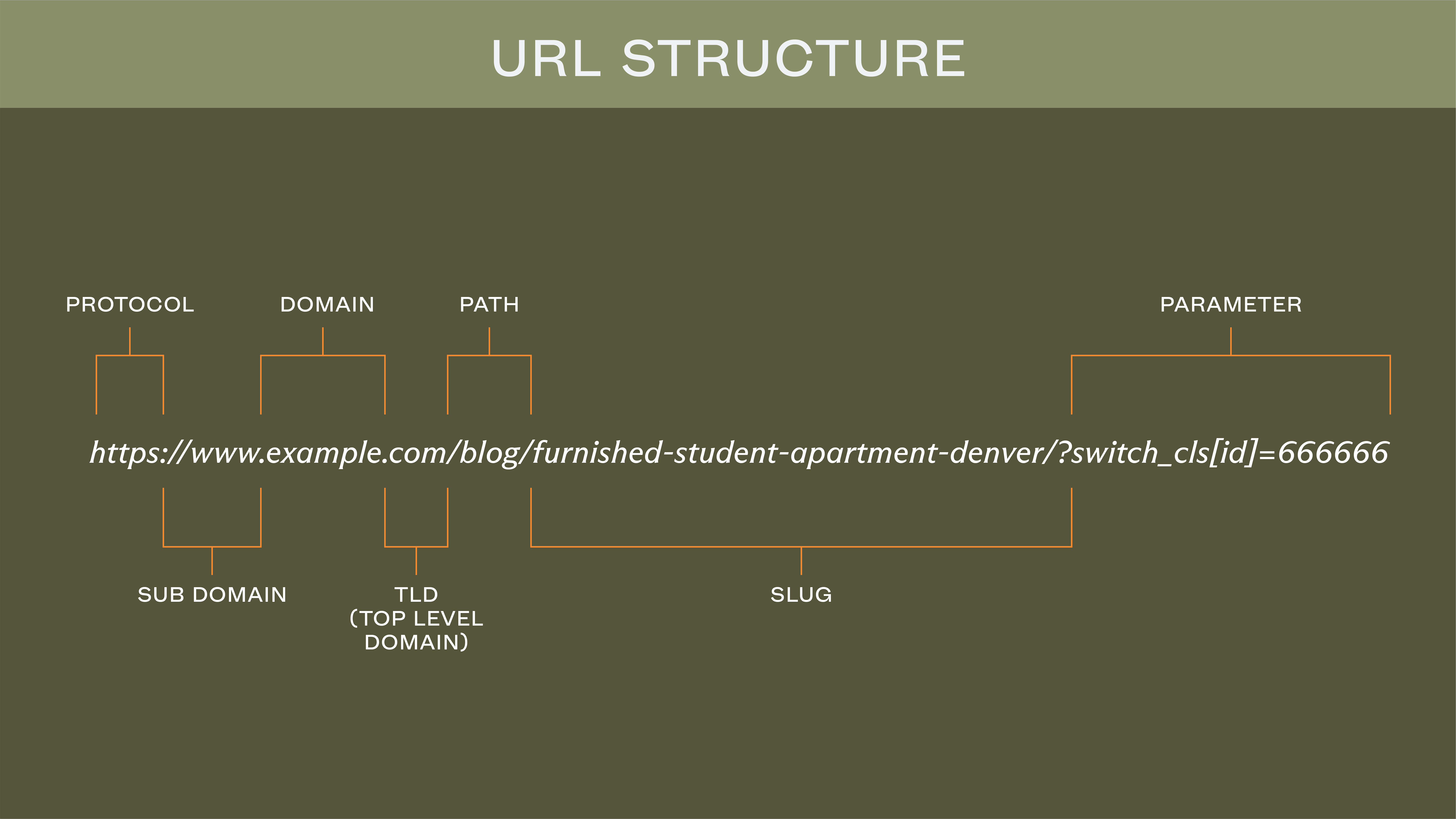
While having an exact match domain (EMD) once provided a significant ranking boost, it is no longer a strong signal. It’s better to choose a domain name that is brandable, memorable, and consistent.
Structured Data (Schema Markup)
Structured data, or schema markup, is code that you add to your website to help search engines better understand your content. It’s not visible to users. For example, using schema markup to specify your community’s name, address, phone number, and hours helps Google classify that information correctly, reinforcing your NAP consistency.
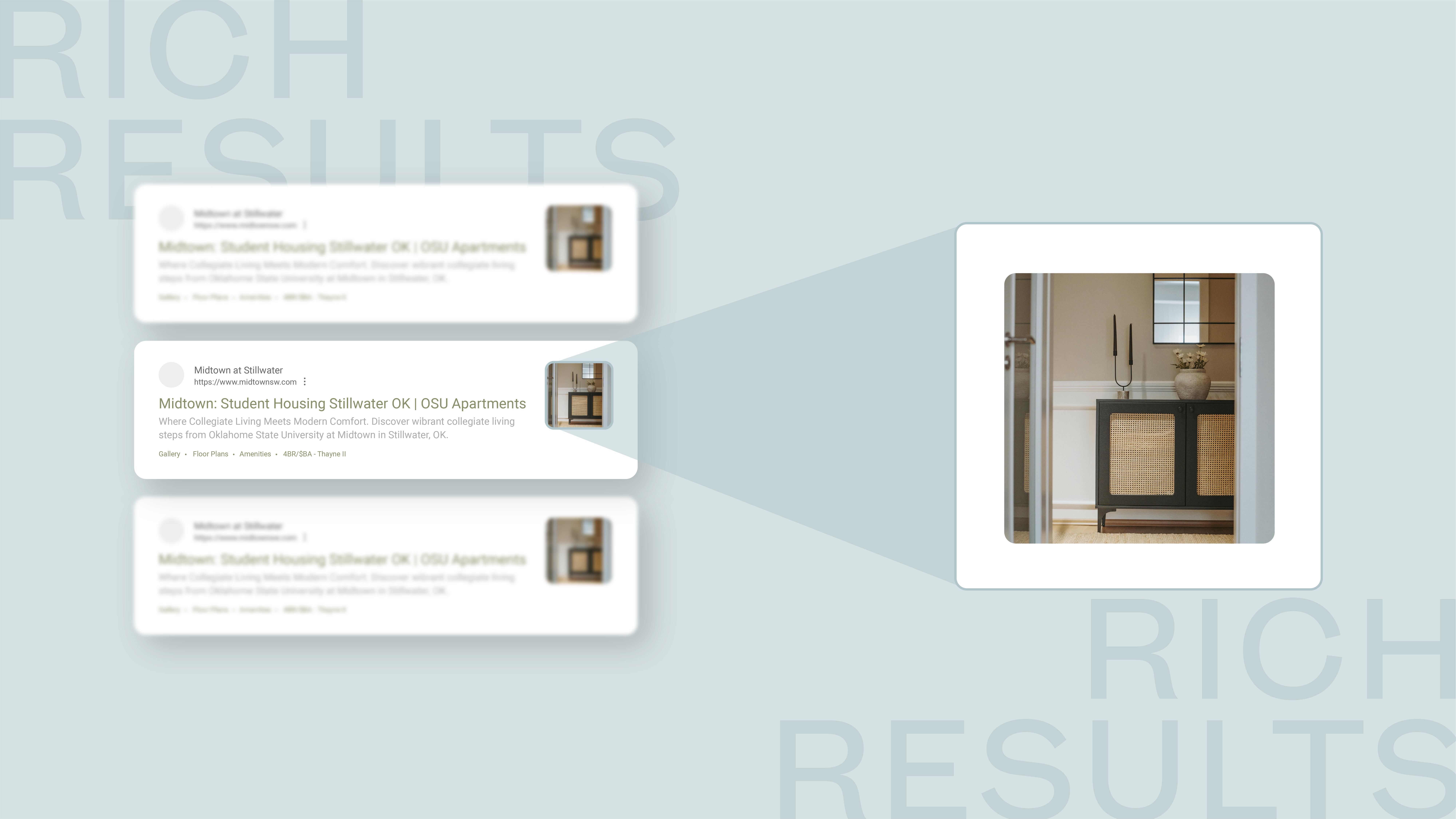
For apartment communities, using ApartmentComplex schema markup can qualify your site for rich results in the SERP, like displaying a specific image next to your listing. It also allows you to list your social media profiles, helping Google connect all aspects of your digital presence.
Site Speed (Core Web Vitals)
Core Web Vitals are metrics Google uses to measure the real-world user experience of a webpage, focusing on loading, interactivity, and visual stability.
- Largest Contentful Paint (LCP): Measures loading performance. A good score is 2.5 seconds or less.
- Interaction to Next Paint (INP): Measures interactivity and responsiveness. A good score is 200 milliseconds or less.
- Cumulative Layout Shift (CLS): Measures visual stability (i.e., how much the page unexpectedly moves around while loading). A good score is 0.1 or less.
A fast, stable website provides a better user experience, which is rewarded by Google with better rankings and by users with better engagement and more conversions. Our teams research into multifamily websites proves this, in an analysis of over 7 million web sessions, we found that CLS is directly correlated with website performance
Our Core Web Vitals case study revealed that a poor CLS score has a moderate negative correlation with Engagement Rate (r=−0.470) and a weak negative correlation with Conversion Rate (r=−0.108). We also saw that underperforming CLS scores are linked to worse search rankings (a weak positive correlation with GSC Position, r=0.245). This data shows that improving your site’s visual stability is important for keeping users engaged and driving conversions.
Understanding AIO & GEO
As search engines evolve, our strategies must evolve with them. Thinking about SEO as just on-page, off-page, and technical checklists is no longer enough. The most effective approach today is a unified one, best understood through the AIO / GEO framework. This model is built to address how both AI-powered search engines and modern users find information.
AIO (AI Optimization): Optimizing for How Search Engines Answer
This is about structuring your website’s information so that artificial intelligence, specifically Google’s, can understand it, trust it, and feature it. The goal is to make your community’s website the definitive source of truth.
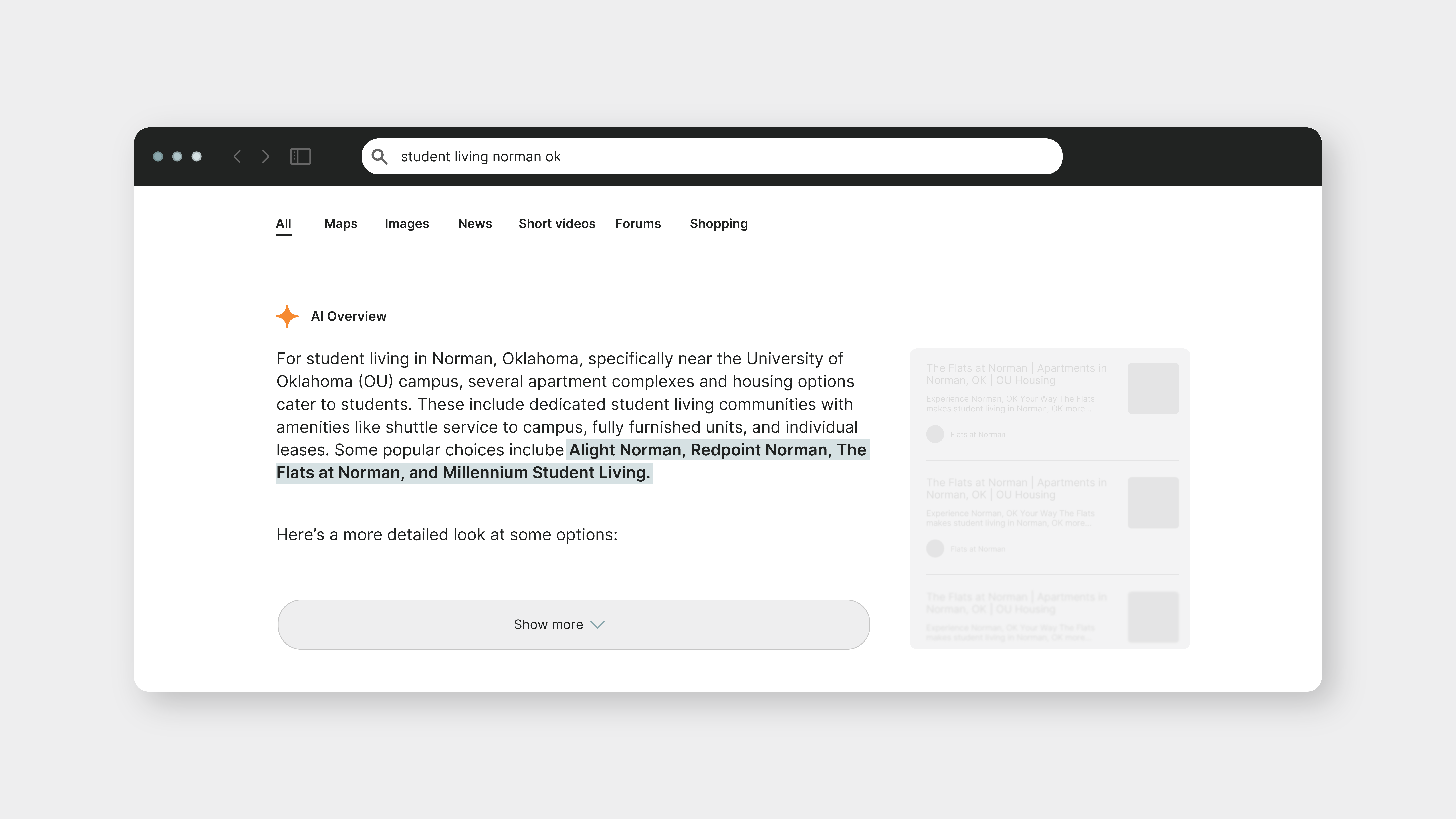
What AIO looks like: The most prominent example is the AI Overview (formerly SGE) at the top of the search results page. When Google’s AI synthesizes an answer for a query like “student living norman ok,” it pulls information from the most authoritative, well-structured, and trustworthy websites. To be featured in that AI-generated answer, your site must provide clear, comprehensive information that Google’s systems can easily digest.
GEO (Generative Engine Optimization): Optimizing for How Users Ask
This is about anticipating the new ways users search for local information. Renters are no longer just typing keywords into a search bar; they are having conversations with AI assistants to find what they need.
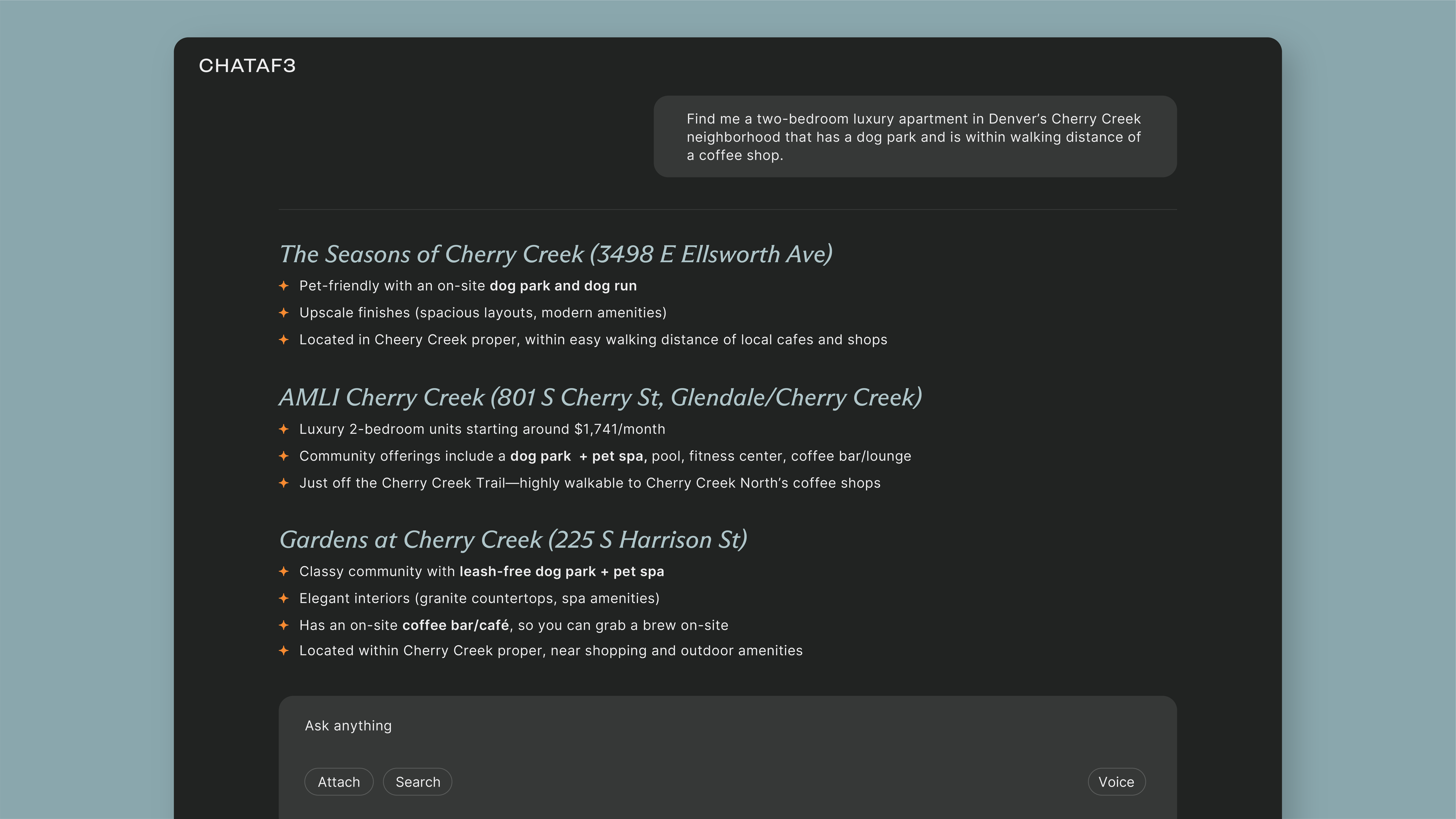
What GEO looks like: A potential renter might ask ChatGPT, Gemini, or another AI chatbot: “Find me a two-bedroom luxury apartment in Denver’s Cherry Creek neighborhood that has a dog park and is within walking distance of a coffee shop.” To be the answer to that complex, conversational query, your digital presence must be rich with geographic context and specific details that an AI model can confidently use to make a recommendation.
Our team analyzed over 21 million website session and found that AI referrals have grown 50,000% YoY (June 2024 vs. June 2025). However, AI traffic is still a small fraction of total volume, representing 0.39% of organic traffic and 0.12% of overall website traffic. Although the overall traffic percentage is nothing to write home about, AI search trends are rapidly evolving and your website needs to be optimized to compete in LLMs.
Take Control of Your Search Rankings
Navigating the world of apartment website SEO can feel like a full-time job. From outmaneuvering national ILSs in the Map Pack to building topical authority with a strategic blog and getting ahead of your competitors in the new world of AIO & GEO, a successful strategy requires a deep understanding of on-page, off-page, and technical factors. But the reward is undeniable: a steady stream of the highest-converting traffic you can get.
By implementing the strategies in this guide, you can build a powerful foundation for long-term organic growth, reduce your reliance on paid advertising, and connect with more qualified renters directly.
If you’re ready to stop competing and start winning in the search results, our team of multifamily marketing experts is here to help. We use proprietary data and proven strategies to put our clients at the top of the SERP.
Contact Agency FIFTY3 today to learn how our SEO services can help you reach your leasing goals.

Sign up for our newsletter.
Stay in the know about our insights and industry trends.
