



Multifamily Generative Engine Optimization (GEO) Trends & Optimization Tactics



Table of Contents
You’ve seen the LinkedIn posts, the update emails from your vendors, and maybe even had questions from your own team. There’s a new acronym floating around, and it’s causing a stir: GEO. What is multifamily Generative Engine Optimization (GEO), and what do you really need to do about it?
Generative Engine Optimization is the practice of creating and structuring content to be effectively understood, synthesized, and presented by AI models like ChatGPT, Gemini, and Perplexity. With 71.5% of people now using AI for search, according to Search Engine Land, this isn’t a trend you can ignore. SEO has been constantly evolving since its inception in the early 90s, and the shift toward prospective residents using AI to find their next apartment is the next major leap.
So, why should you listen to us? Because we don’t deal in speculation.
The SEO team at Agency FIFTY3 analyzed 21,958,811 sessions from over 390 multifamily websites to uncover the real story behind AI search traffic. We have the definitive metrics on how AI is impacting your community’s organic presence right now, and we’re sharing the optimization techniques you should double down on, and which ones you can ignore.
Key Takeaways
- Traffic from AI searches as a share of all website traffic has increased 50,000% YoY (June 2024 vs. June 2025).
- The most popular AI tool in multifamily is ChatGPT, driving 91% of all clicks from AI searchers.
- Despite massive growth, AI traffic is still a small fraction of total volume, representing 0.39% of organic traffic and 0.12% of overall website traffic.
- Community websites with an SEO-optimized blog receive 50% more average monthly traffic from AI searches than those without.
Understanding Generative Engine Optimization
Generative Engine Optimization (GEO) is the latest evolution in Search Engine Optimization (SEO). It’s the practice of optimizing your online content so it can be easily featured in the AI-generated answers of search engines and standalone platforms like ChatGPT, Gemini, and Perplexity.
This isn’t just a niche behavior. This new way of searching for information, including apartments, has delivered the first real shakeup to Google’s dominance in years. In the U.S. alone, Google’s search engine market share dropped from 90% in November 2024 to 86% in July 2025.
So, what does an AI search result actually look like?
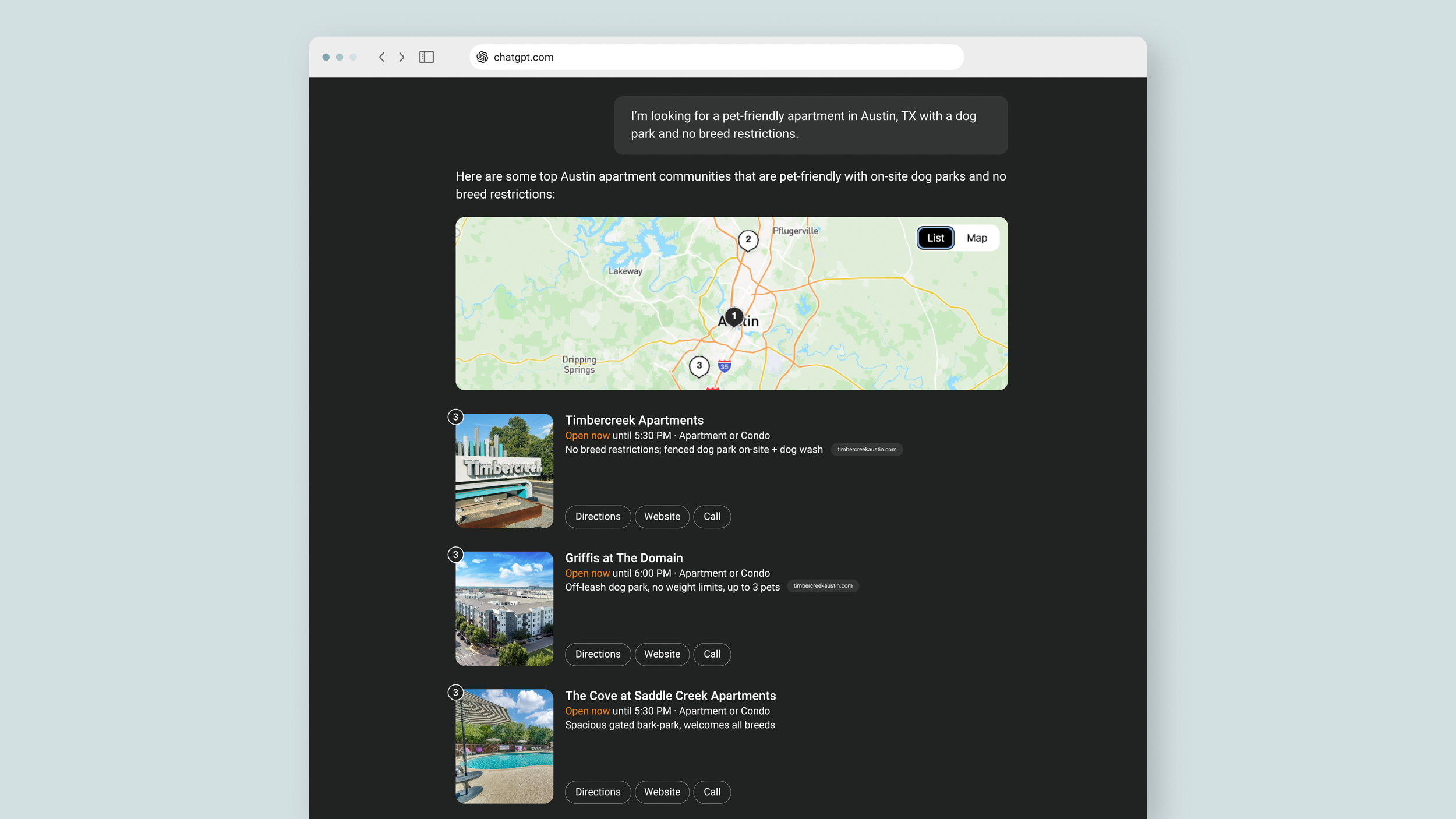
Much like a traditional Google search engine results page (SERP), the layout depends entirely on the query. An AI model infers what you’re looking for and formats its answer accordingly. For example, if you ask ChatGPT for apartment options, it might display a map with three pinned results, which looks very similar to the “map pack” on Google.
In other searches, the AI skips the visuals and provides a purely text-based answer with sourced links.
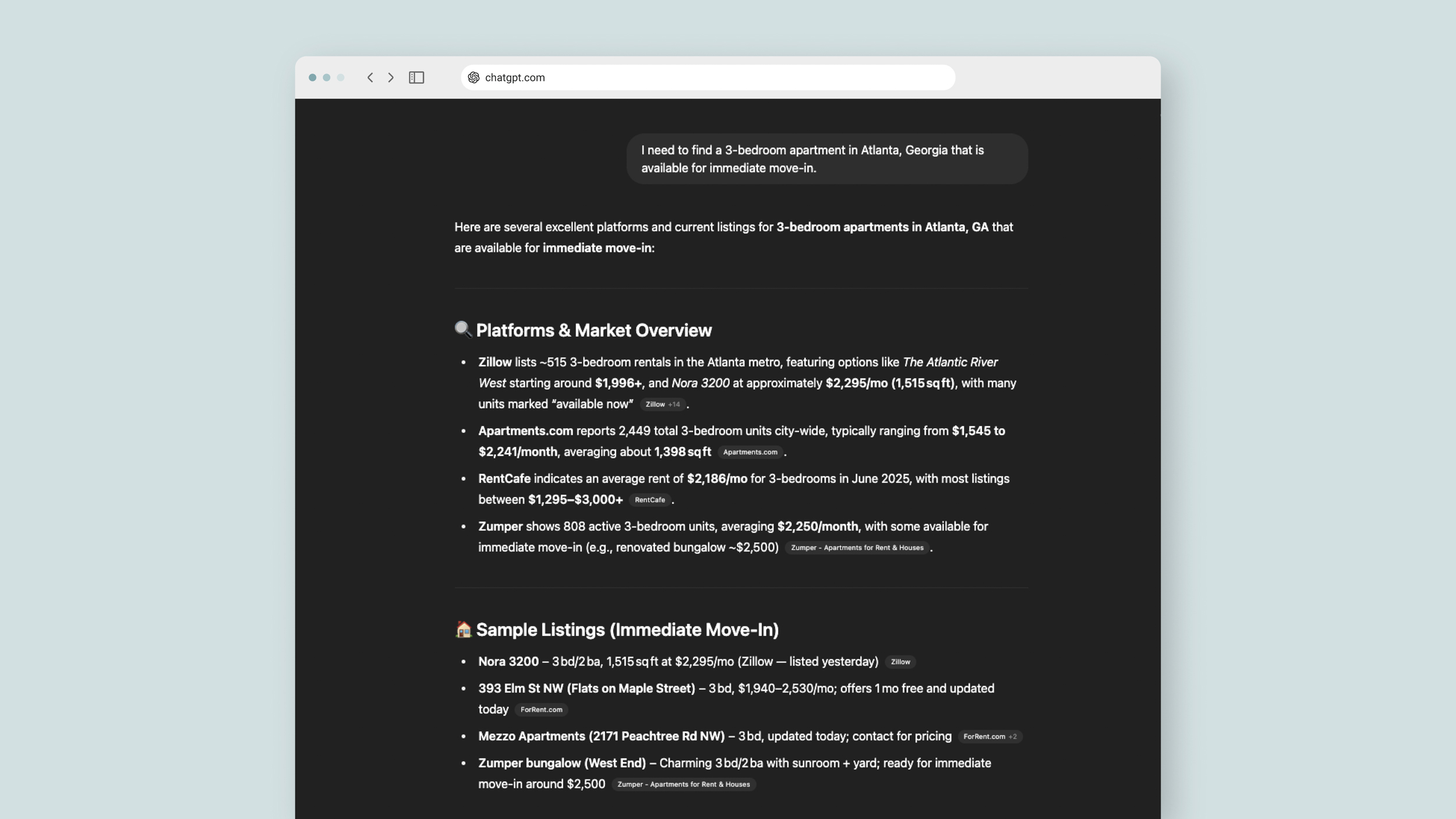
The critical takeaway is that regardless of the format, the AI provides source links. These links can point to a community website, an ILS, or even a Reddit thread. This brings up a crucial question for your strategy: what kind of links are most common for apartment-related searches?
Most common link types in apartment AI searches
To figure out what AI models prioritize, our team ran numerous apartment-related queries through ChatGPT. (You’ll see why we focused on ChatGPT in a moment). One of the biggest shifts with AI is the rise of conversational search. Prospects aren’t just typing keywords; they’re asking detailed questions, and they expect a nuanced answer.
This conversational nature means the AI learns from a user’s chat history to deliver increasingly relevant results. For you, this is good news. It means prospects are more educated about your community before they even click to your website, resulting in more qualified traffic.
Consider the difference:
- Google Search Query: luxury apartments in miami
- AI Search Query: what are the top-rated pet-friendly luxury apartments in miami based on reviews with immediate availability?
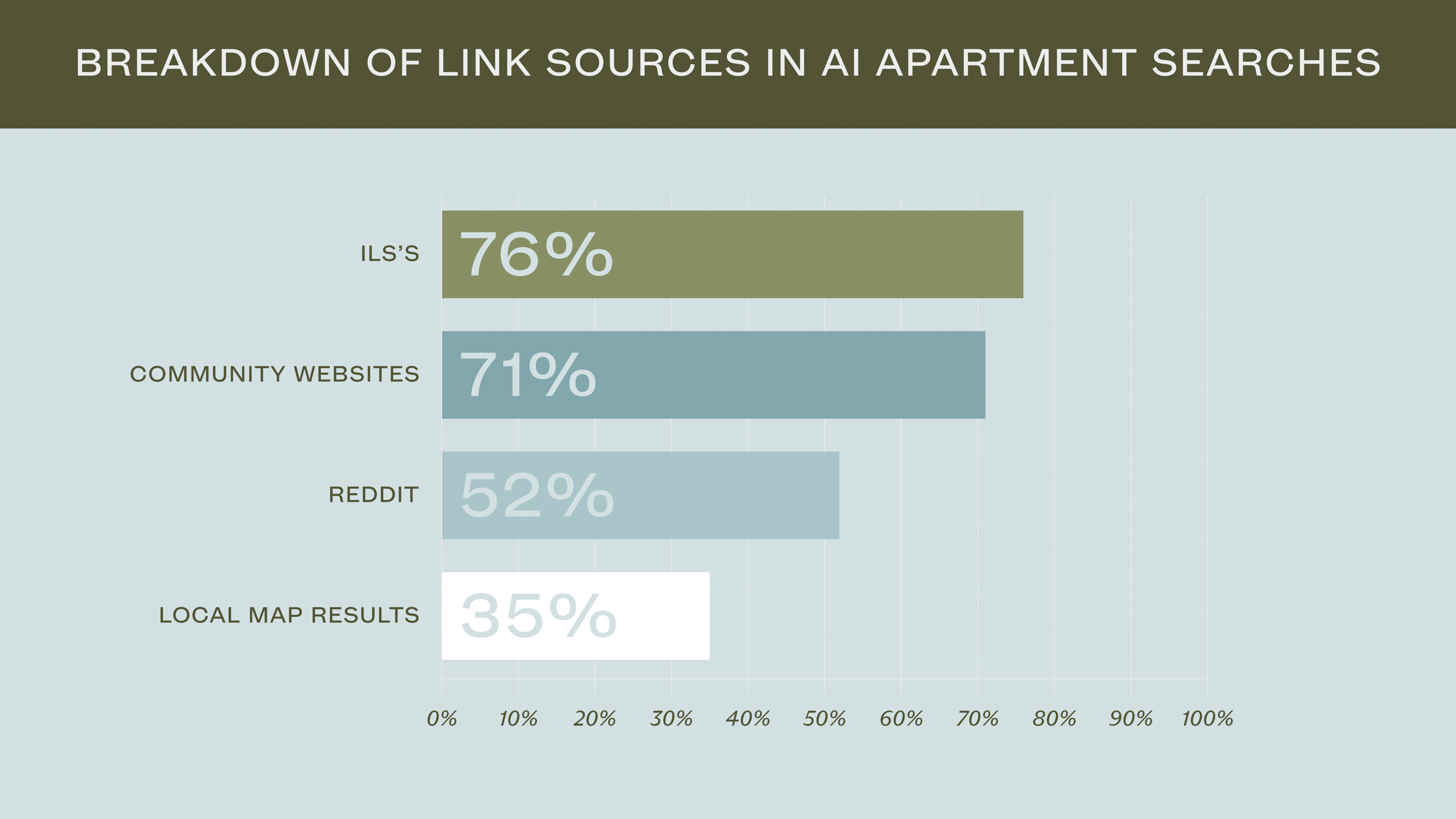
When we analyzed the results from these types of AI search queries, we found four primary link types:
- ILS’s: Platforms like Apartments.com, Zillow, and RentCafe.
- Community Websites: A direct link to a single property website.
- Reddit: Community forums for firsthand resident feedback.
- Local Map Results: A map with three pinned communities, with links that open in Google or Apple Maps.
Our analysis shows that links to Internet Listing Services (ILS) are the most common, appearing in over 76% of search results. Direct links to apartment community websites are a close second, featured in nearly 71% of all responses. For firsthand experiences, community forums like Reddit are a significant source, included in over 52% of results, while a visual local map assists in just over 35% of queries.
Understanding what this means for your community’s marketing is crucial. While a new search method is growing, GEO doesn’t demand you throw out your playbook. It simply raises the stakes on the SEO fundamentals that always worked best.
GEO vs. SEO
Every few years, a new marketing acronym sends teams scrambling. In 2025, that acronym is GEO, and it has many marketers worried their entire SEO strategy is now obsolete. It’s not.
The move toward AI search is a direct response to the frustrations of traditional search engines, where users have to sift through low-quality, keyword-stuffed pages built for algorithms, not people. AI models act as a powerful quality filter, cutting through the noise and bypassing outdated ranking signals that can be easily manipulated. They seek out and synthesize information from only the most credible and well-structured sources.
This is why GEO is not a revolution in website optimization tactics, but rather a forced realization.
You can no longer get by on outdated SEO tactics like thin content, keyword stuffing, and low-quality backlinks. To be cited and linked in an AI search, you must execute the strategies that have always defined effective SEO: creating genuinely valuable content for your audience.
| Factor | Modern SEO Fundamentals | GEO Emphasis |
|---|---|---|
| Core Focus | Build topical authority and demonstrate E-E-A-T (Experience, Expertise, Authoritativeness, Trust) to satisfy user intent. | Prove verifiable authority and factual accuracy. The AI must trust your data enough to state it as a fact and present you as the definitive, citable source. |
| Content Strategy | Develop comprehensive, user-centric content that thoroughly answers a user’s potential questions on a subject. | Create highly-structured, “AI-readable” content with clear formatting (table of contents, lists, H2s/H3s, FAQ sections) and specific, extractable data points (stats, prices, dates). |
| Off Page Optimization | Build authority through backlinks from reputable sites (e.g., guest posts, digital PR) and ensure consistent directory listings (citations). | Shift focus from link authority to the sentiment and context of brand mentions. The AI synthesizes data from reviews (Google, ILSs), forum discussions (Reddit), and articles to build a holistic understanding of your real-world reputation. |
| Technical Optimization | Implement structured data (Schema), with a primary focus on markup that qualifies for Google’s rich results to enhance visibility on the SERP. | Adopt a holistic schema strategy. The goal is to use all applicable schema types to create a comprehensive, machine-readable blueprint of your page’s content for the AI, regardless of whether they produce a visible rich result. |
| Optimization Goal | Secure a high rank on the Search Engine Results Page (SERP), aiming for top positions and featured snippets. | Become a cited source within the AI-generated answer. The primary win is being the source of the information, not just a link below it. |
| Measurement of Success | Keyword rankings, organic traffic, conversion rate, and impressions from the SERP. | Brand mentions/citations in AI responses, referral traffic from source links in AI answers, and user conversion rates. |
Which AI models are the most popular for apartment searches?
To pinpoint where you should focus your efforts, we analyzed over 21 million user sessions across more than 390 multifamily websites. The results are decisive. The AI search market is dominated by a single platform: OpenAI’s ChatGPT is the undisputed leader, driving an overwhelming 91% of all AI-driven referral traffic.
The rest of the field lags far behind. Google’s Gemini accounts for just 5% of this traffic. Other models like Perplexity (3%) and Microsoft’s Copilot (1%) hold even smaller shares, while platforms like Claude and Grok represent a negligible fraction of current volume.
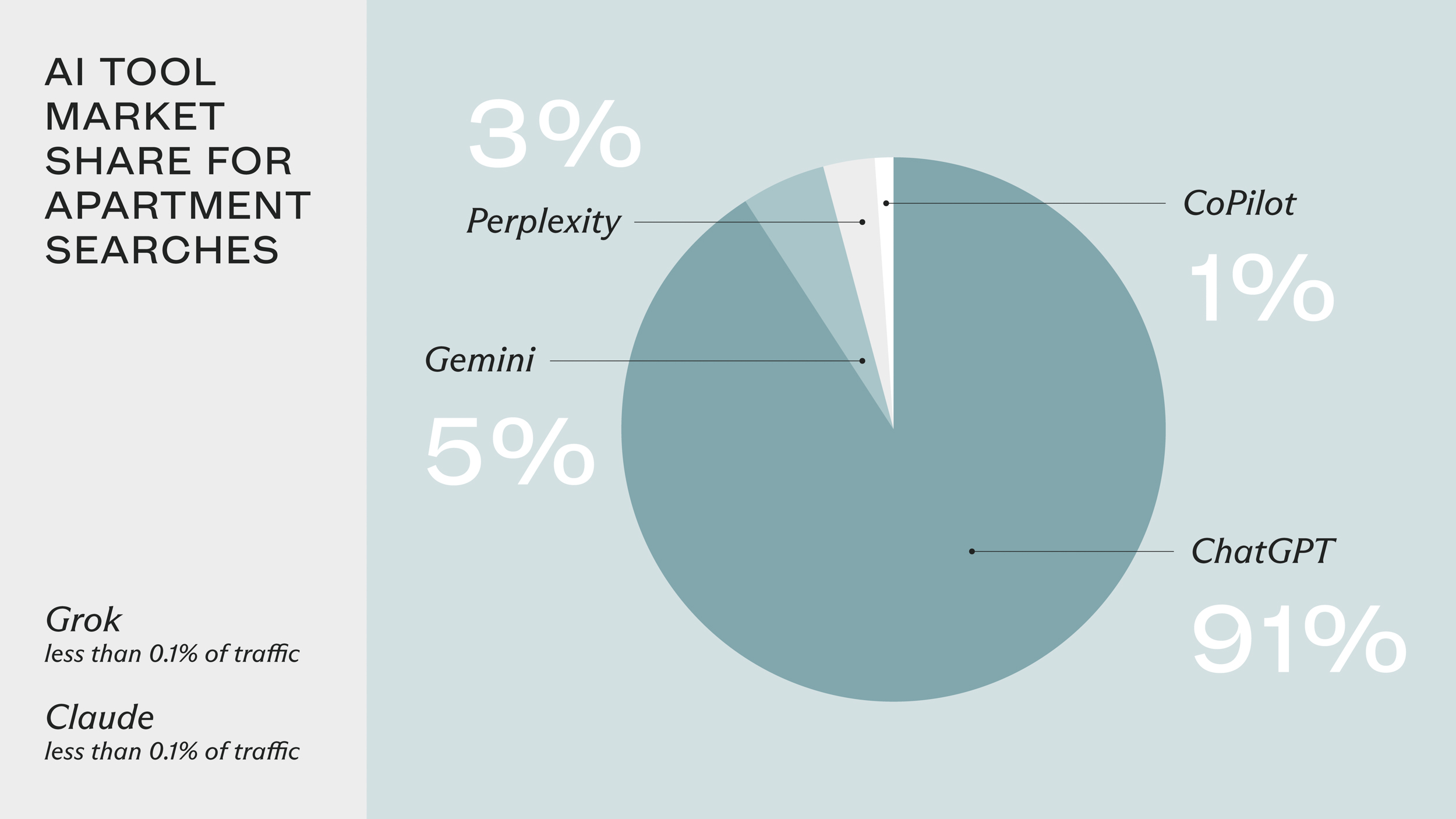
Just as Google has long dominated traditional search, ChatGPT is the clear favorite among today’s AI-powered apartment searchers. This raises the most important question for any marketer: is this traffic actually valuable? The answer is in the data.
AI traffic quality via Google Analytics metrics
To measure the true impact of this new traffic source, our team analyzed user behavior in Google Analytics 4, focusing on Engagement Rate, Sessions Per User, and User Conversion Rate for actions that generate a guest card (contact forms, tour requests, and applications).
The data shows this is not passive browsing; it’s high-intent traffic.
Users arriving from AI search platforms are highly engaged. They spend an impressive 4.5 minutes (262.66 seconds) on average per session, leading to a 73.62% engagement rate.
More importantly, that engagement converts. A solid 3.84% of these users take the next step, with 1.71% submitting an application, 1.46% filling out a contact form, and 0.68% scheduling a tour.
But how does it stack up against your best-performing channel, Organic Search?
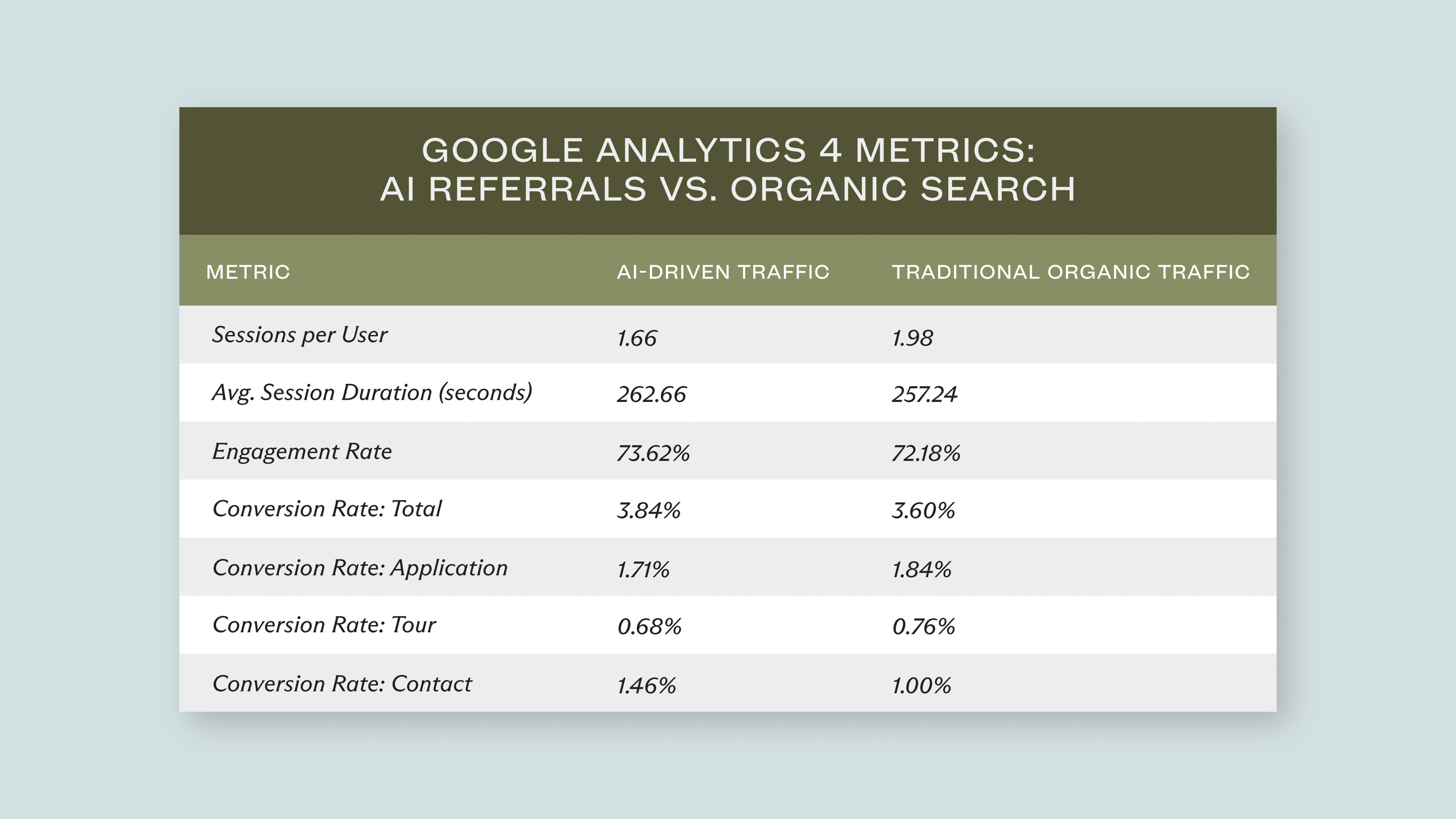
While traffic from AI search shows slight improvements in Conversion Rate, Engagement Rate, and Average Session Duration over traditional organic search, the difference is not yet statistically significant. Given that organic traffic is already the gold standard, it’s incredibly promising to see AI search performing at the same high level. We just have to remember that this new way of discovering apartment communities is still in its infancy.
AI search traffic growth
When we look at the big picture, AI search traffic isn’t making the massive splash that marketing headlines might suggest. At least, not yet.
Looking at our data from June 2024 to June 2025, sessions from AI search tools as a share of overall website traffic have increased by a staggering 50,000%.
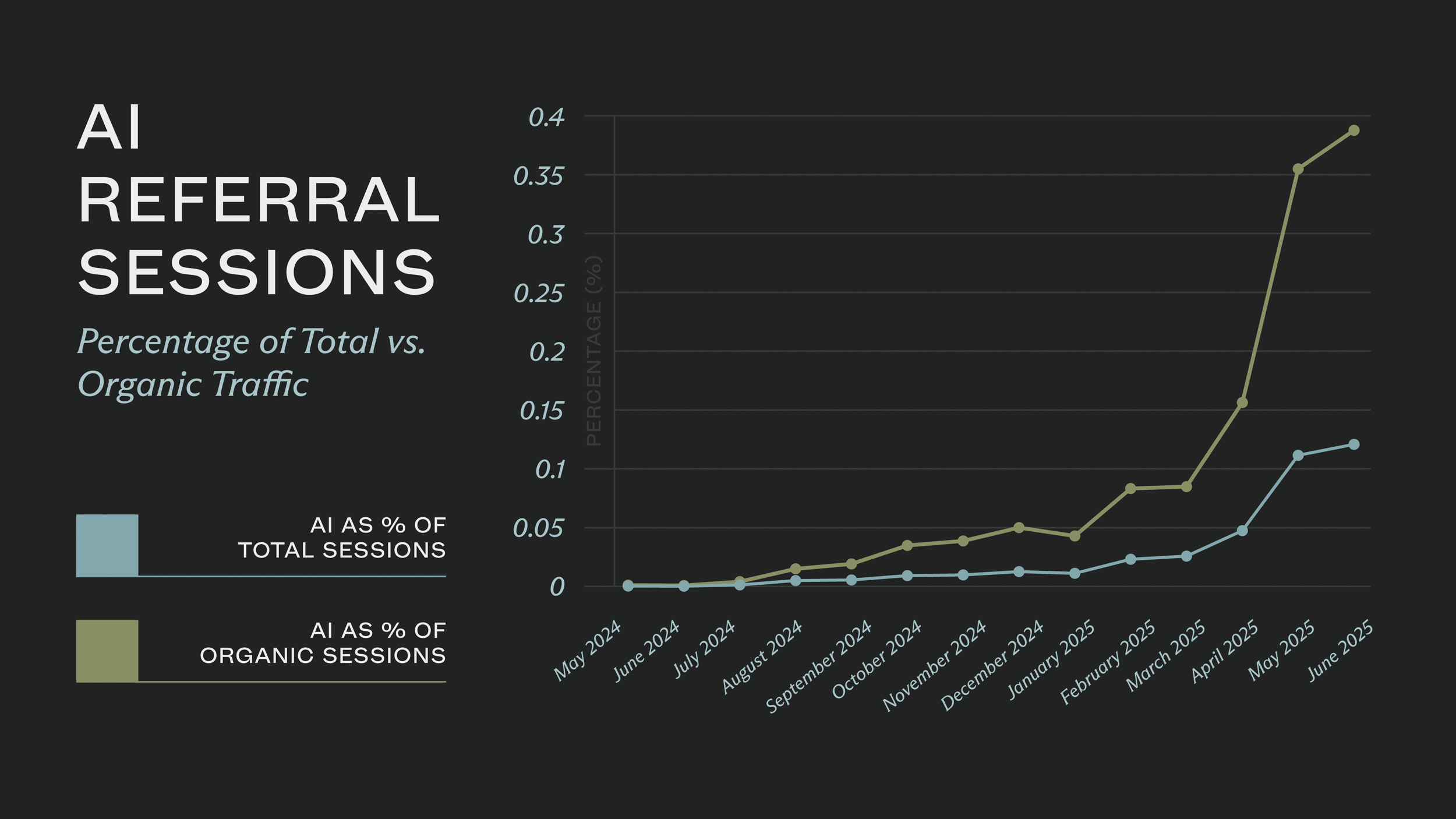
While that growth is astronomical, it’s important to keep it in perspective. AI search is still a small slice of your overall traffic.
- Organic Traffic: AI search accounts for 0.39% of all organic traffic.
- Overall Traffic: AI search accounts for 0.12% of all website traffic.
This is the very beginning of a major shift in search behavior. We are confident that as user patterns evolve, the share of traffic from AI search will increase. The work you do now will determine whether you lead the pack or get left behind.
How to set up your website for Generative Engine Optimization success
Optimizing for GEO doesn’t require you to reinvent your marketing strategy. It demands a deeper, more disciplined commitment to the foundational SEO practices that have always separated great digital marketing from the rest. The path to becoming a trusted, citable source for AI is paved with the same best practices that build trust with users.
This means focusing on areas such as: allowing AI crawlers to access your site, creating high-value blog content, developing comprehensive FAQ pages, leveraging advanced schema markup, and maintaining flawless information consistency across the web.
Cloudflare AI crawler blocking settings
As of July 1, 2025, Cloudflare, a service that powers about 20% of the web, began blocking AI crawlers by default. This means you may be unintentionally preventing AI models from accessing your content, making it impossible for them to include you in their answers.
While this setting may be useful for some websites, it can render your apartment community invisible to a growing audience of renters. Contact your website provider immediately to ensure this default setting is not hindering your AI search visibility.
FAQ pages that provide value
Well-built FAQ pages are a goldmine for GEO. They perfectly align with how AI models process information: by finding direct, concise answers to specific questions.
A structured FAQ page, especially one built from the real questions your leasing team answers every day, formats your content in the ideal way for an AI to consume. It breaks down topics into clean question-and-answer pairs, creating the kind of “AI-readable” content that an engine can easily parse, understand, and use as a citable source. Instead of trying to interpret a dense paragraph of marketing copy, the AI can pull a direct question and its corresponding factual answer, making your website a highly reliable source.
Blog posts to create topical authority
SEO-optimized blog posts have always been a winning tactic in multifamily, where most community websites feature the same few pages with thin content. AI search engines only amplify their importance.
An AI favors a well-structured blog post: it makes finding, understanding, and citing information incredibly efficient. Our analysis of over 390 multifamily websites confirms this. We found that communities with a blog strategy receive 50% more referral sessions per month from AI search engines than those without a blog.
It’s clear a blog is crucial. These tactics will help take your content from good to great.
Table of Contents: This acts as a roadmap for users and AI crawlers, with anchor links that allow an AI to jump directly to the most relevant section to answer a query.
- Key Takeaways: This is a pre-written summary. It allows an AI to instantly grasp your article’s core message and use it for high-level, summary-style answers.
- Clear Heading Structure (H1, H2, H3): This creates a logical outline. AI models use this hierarchy to understand the main topics and sub-topics, grasping the context and relationship between different pieces of information.
- Tables: For comparisons and data, tables organize information into a highly-structured format that is exceptionally easy for an AI to parse and extract specific data points from.
- Blockquotes: This formatting signals an important excerpt, making it easy for an AI to identify key takeaways or citable snippets to use in its responses.
- Internal Linking: Linking to other relevant posts on your site helps AI models discover more of your content and understand the topical relationships between your pages, reinforcing your website’s overall authority.
- In-Depth Info to Provide Topical Authority: Comprehensive content demonstrates a deep understanding of a topic, making your website a more reliable source for an AI.
- Clear, Minimal Fluff Writing Style: Speak the AI’s language. AI models are data-processing systems that prioritize clarity and factual accuracy over persuasive, ornate language.
- Author Bios: Author bios are a critical signal for E-E-A-T (Experience, Expertise, Authoritativeness, Trust). They tell an AI who is providing the information and why they are a credible source.
- FAQ Sections: These directly mirror the conversational nature of AI search, formatting your content in the exact way an AI needs to find and deliver a response.
Create a blueprint with advanced Schema Markup
For years, the goal of schema markup was narrow: implement just enough code to win a rich result on Google. For AI search, that is no longer enough. The focus must shift from enhancing a search result to comprehensively defining your entire business as a network of interconnected digital entities.
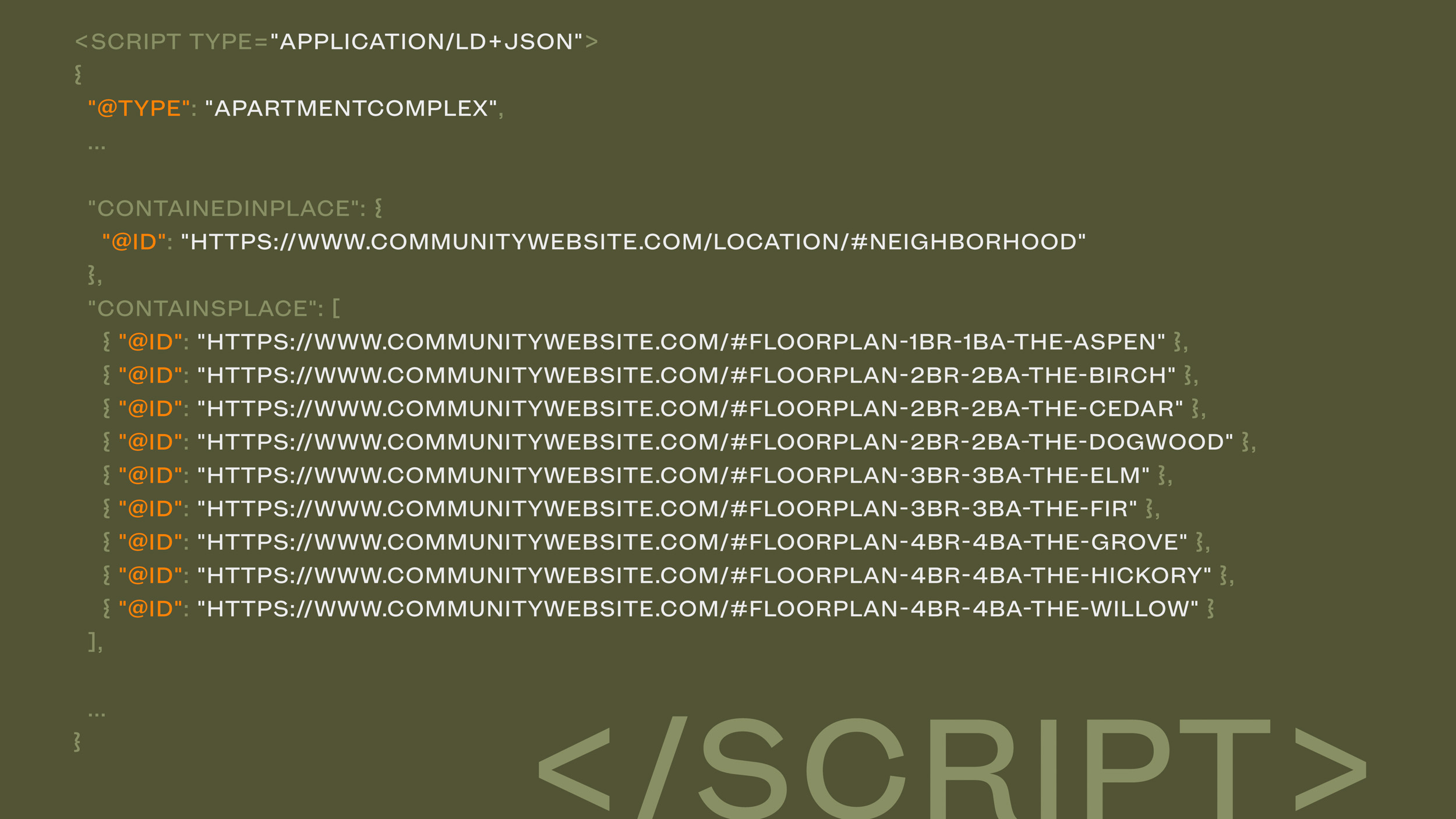
Think of advanced schema as a detailed, machine-readable blueprint of your website. While an AI is good at reading your content, schema explicitly tells it: “This page represents an ApartmentComplex. It is located in this Neighborhood and contains these specific FloorPlan entities.” It is a direct communication channel to the machine, removing any chance for misinterpretation.
For example, the schema snippet below uses containedInPlace to link a community’s homepage to its location page, proving the community is located within that neighborhood. It also uses containsPlace to show the relationship between the community and the individual floor plan entities it contains.
Information consistency across digital sources
When an AI finds the exact same information about your property across your website, your Google Business Profile, and major ILSs, it treats that data as a verifiable fact. Even minor inconsistencies create doubt and can cause an AI to ignore your information in favor of a competitor’s.
If AI assistants are constantly outputting incorrect information about your community, it erodes trust with potential residents before they even reach your website.
- NAP Consistency: Your Name, Address, and Phone number must be identical everywhere. This is the foundation of your digital identity.
- Google Business Profile (GBP): Your GBP is a primary data source for AI. Mismatched pricing or availability on the “Product” cards for your floor plans creates a direct data conflict that destroys an AI’s trust in your information.
- Major Apartment ILSs: Our data shows ILSs appear in over 76% of AI search results for multifamily queries, making consistency here critical. Your amenity lists, pet policies, and floor plan availability must perfectly mirror what’s on your website.
Clean and easy to read sitemap.xml
Let’s talk about your sitemap. Not your visual sitemap that represents your community’s layout, this sitemap is made exclusively for Google’s crawlers and is not visible to your website users.
Think of it like this: you’ve just created all this amazing content—in-depth blogs, detailed FAQs, specific floor plan pages. Are you going to hope the AI crawler stumbles upon it, or are you going to hand it a map? Your sitemap.xml file is that map.
AI crawlers, just like Googlebot, have a limited “crawl budget.” A clean sitemap tells them exactly where to find your most valuable pages first. It ensures they discover your new content the moment it’s published, getting it into their systems faster.
A “clean” sitemap:
- Includes only your high-value pages.
- Excludes junk like redirects, 404s, and non-canonical URLs.
- Is always up-to-date.
- Is submitted via Google Search Console.
Don’t overlook this. A solid sitemap is a simple handshake that makes every other GEO effort more likely to pay off.
The Bottom Line on AI Search
Let’s be real. After all this talk about AI, crawlers, and a new acronym, it’s easy to think you need to tear up your entire marketing plan. You don’t.
The secret to “optimizing for AI” is that it isn’t a new trick. It’s about finally getting serious about the hard work that has always defined great SEO. For years, marketers have gotten away with thin content and digital shortcuts. GEO is the wake-up call. AI models are smart enough to ignore the fluff and reward genuinely helpful, well-structured, and fact-based content. The kind of content you should have been creating for your human audience all along.
Getting ahead of GEO means building your foundation now. By focusing on creating killer blog content, building useful FAQ pages, and ensuring your property’s information is consistent everywhere online, you’re not just chasing an algorithm. You’re investing in a better user experience, and that is what will make you the definitive source for both renters and AI for years to come.
If you need a partner to improve your website’s visibility and build a future-proof organic strategy, let’s talk. The team at Agency FIFTY3 is ready to help.
* For readability, some percentages and figures in this article have been rounded. This rounding does not change the core findings or message of our research.

Sign up for our newsletter.
Stay in the know about our insights and industry trends.
